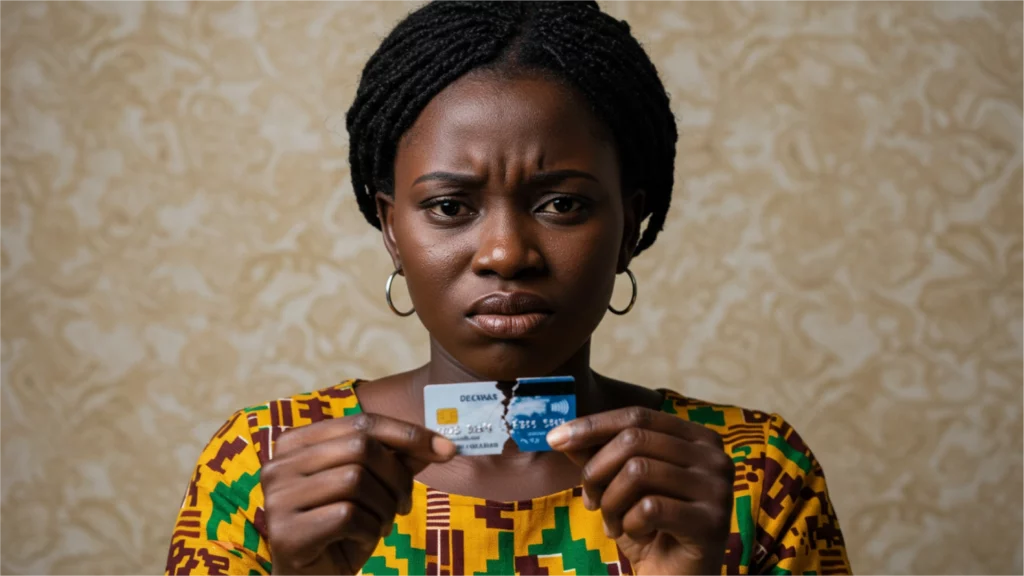
Not too long ago, a friend in Accra shared a frustrating experience. She took a short-term loan from a digital lender, paid it off as agreed, but then got charged again a week later. Turns out, the lender had set up a recurring card debit, and the system didn’t recognize that she’d already repaid. She called the lender, her bank, and even the Payments Systems Department of the Bank of Ghana. It took weeks to get her money back.
If you’ve worked in lending in Ghana or anywhere in Africa, really, you’ve probably heard stories like this. And while South Africans mostly rely on debit orders, Ghana’s card infrastructure is built differently, and it’s not built for loan collections. In fact, relying on debit cards for loan repayments in Ghana might just be a fast track to rising defaults and frustrated borrowers.
Here’s why debit cards simply don’t work well for loan collections in Ghana.
Card ownership is low, especially outside big cities
If you’re in Accra or Kumasi, you might know quite a few people with debit cards linked to their bank accounts. But once you leave the big cities and head to smaller towns or rural areas, you quickly realise that debit cards aren’t very common. Most folks don’t have easy access to banks, and instead, they use mobile money services on their phones to send and receive money. Here’s the reality: according to the World Bank’s 2021 data, only about 17% of Ghanaians aged 15 and up actually own a debit card. In South Africa, on the other hand, that number is much higher, almost 59% of people have one. That’s a big difference.
Plus, when you look at who has any kind of bank account, including mobile money, only around 39% of Ghanaians do. In South Africa, over 84% of people have some kind of bank account. This shows just how many Ghanaians rely on informal financial tools rather than banks and cards.
For lenders focused on mass market reach, which includes traders, informal workers, artisans, and rural entrepreneurs, this is a fundamental mismatch. The very people who need access to small loans the most are the ones least likely to own or use debit cards. So if you’re trying to build a lending business in Ghana and your collections strategy relies heavily on debit card, you’re building on a shaky foundation from the start.
Also read: Which is better for loan repayments: Cards or Direct Debit?
Cards aren’t the main way people pay, mobile money runs the show
If you want to understand how most Ghanaians handle money these days, just look at their phones. Ghana is known as one of the biggest mobile money hubs in Africa. According to the Bank of Ghana’s latest figures, more than 90% of adults have access to a mobile money account. That means nearly everyone, from big city to small-town people, uses mobile money services like MTN MoMo, AirtelTigo Cash, or Vodafone Cash to send, receive, and store money.
Mobile money isn’t just popular; it’s the preferred way to handle everyday payments. Why? Because it’s quick, convenient, and doesn’t require a traditional bank account or card. People can pay bills, transfer money, buy airtime, and yes, even repay loans with just a few taps on their phones, no card needed.
When it comes to repaying loans, this makes a huge difference. Most borrowers are more comfortable sending payments through their mobile money wallets than trying to use debit cards, which might require them to visit a bank, deal with card fees, or worry about card security. For many, mobile money feels safer and more straightforward.
So, if a lender insists on collecting repayments through debit cards in Ghana, they’re basically ignoring how their customers actually want to pay. It’s like opening a restaurant but refusing to serve the local favourite dish. You risk losing borrowers to lenders who offer easier, more accessible repayment options.
Also read: Are you still chasing payments? Direct debit can turn your loan collections around
Fraud and trust issues make people nervous about card payments
From stories shared on social media to actual experiences with unauthorized debits, many people have learned the hard way that using your debit card online can come with risks. It’s not uncommon to hear of people waking up to find money mysteriously missing from their accounts after entering their card details on a website or app. And once trust is broken, it’s very hard to rebuild.
That fear has made a lot of people cautious. Some flat-out refuse to use their debit cards for anything other than ATM withdrawals. Even if they have a card, many borrowers would rather not put it on file for recurring loan repayments. They’d rather have full control over when and how money leaves their account. With mobile money, for example, they can see the transaction happening in real time and confirm it themselves. With cards, especially those tied to auto-debit systems, there’s a sense of being “at the mercy” of the lender or platform.
But it doesn’t stop there. In some cases, borrowers go a step further, they’ll intentionally block or freeze their card right after receiving a loan, just to prevent automatic deductions. It sounds extreme, but it’s a workaround that some borrowers use when they’re not ready or not willing to repay. And that’s a serious problem for lenders who depend on debit cards for collections. If a borrower disables the card, the lender has to chase them down through phone calls, emails, or even field agents. That adds cost, time, and stress to an already delicate loan process.
Beyond the operational headache, this also weakens the credit ecosystem as a whole. When borrowers evade repayment using these tactics, it undermines trust between lenders and borrowers. It discourages new lenders from entering the market and ultimately limits access to credit for everyone, including honest borrowers who actually intend to repay.
Recurring card debits aren’t reliable in Ghana
In Ghana, recurring card debits depend on a patchwork of systems; card tokenization, payment gateways, internet reliability, and banking cooperation. And that patchwork often has holes.
First, card tokenization: the process of turning a card number into a secure digital token for repeated use, can either be a hit or a miss. If the original card is lost, expired, or replaced (which happens more often than you’d think), the token becomes invalid. That means your repayment attempt fails, even if the borrower has funds.
Then there’s the issue of network stability. Payments rely on uninterrupted communication between banks, processors, and payment gateways. Any glitch in that chain, a slow connection, server downtime, or API failure, can cause a transaction to fail. And in Ghana, where digital infrastructure is still maturing, these hiccups are not uncommon.
But perhaps the biggest obstacle is the banks themselves. In a bid to protect customers, many Ghanaian banks are quick to block repeated or automated card debits, especially if a customer disputes a charge or flags it as suspicious. And they often do this without notifying the lender. The result? You could have a valid loan agreement, with a card on file and a scheduled repayment date, but still be unable to collect the money because the bank stepped in to stop it.
Then there’s the very human reality of insufficient funds. Since most debit cards are tied to current accounts, and many Ghanaians don’t keep large balances in their bank accounts, your debit attempt might fail simply because there’s nothing to collect. Mobile money, in contrast, is where people actively store and manage their day-to-day funds, meaning you’re more likely to find money there when the repayment date comes around.
So while recurring card payments may sound efficient in theory, the on-the-ground experience in Ghana paints a different picture. Between expired cards, blocked debits, payment gateway issues, and empty accounts, the failure rate is just too high for it to be a reliable strategy for serious loan collection.
For lenders, this isn’t just a technical problem, it’s a business risk. If you can’t predict your cash flow because collections fail without warning, you can’t plan, grow, or support your borrowers properly. That’s why smart lenders in Ghana are shifting toward more dependable repayment channels.
Also read: How to get your loans repaid with Direct Debit
Dispute resolution is slow and painful for everyone involved
Card payments come with their fair share of drama, especially when things go wrong. One of the most frustrating issues for both borrowers and lenders in Ghana is how painfully slow and inefficient dispute resolution can be. If a borrower sees an unexpected charge, maybe a double debit, a failed refund, or a deduction they didn’t approve, they’ll likely raise a complaint with their bank. And that’s where the long wait begins.
In many cases, borrowers are told to wait 5 to 14 working days, or longer, just to have the issue “investigated.” During that time, they’re usually stuck in limbo, unable to access the disputed funds and getting bounced between the bank, the card issuer, and the lender. And in some cases, they never get a clear answer. That creates a lot of frustration and confusion, especially when money is tight and every cedi counts.
While banks and payment processors often follow formal dispute handling processes (typically guided by Visa and Mastercard frameworks), the reality is that many local institutions lack the infrastructure, urgency, or customer support capabilities to resolve these cases quickly. Borrowers might have to fill out physical forms, make multiple visits to the bank, or chase after updates over the phone with little success. It’s exhausting.
And guess who the borrower ends up blaming? The lender. Even if the fault lies with a payment gateway or bank, the borrower usually sees the lender’s name on the transaction and assumes it’s their mess. This damages the lender’s credibility and breeds mistrust, especially when it seems like the lender is “hiding” behind slow, faceless banking systems.
Now imagine this happening to a first-time borrower who was already skeptical about using formal credit. One bad experience with a disputed card payment could push them away from the formal lending system for good. And that’s not just a lost customer, it’s a blow to the entire goal of expanding financial inclusion.
For lenders working hard to build trust, grow their reputation, and serve underbanked communities, this is a serious risk. You can’t afford to lose good customers to poor backend processes that are out of your control.
So what should lenders in Ghana do instead?
The reality is that debit cards may work for e-commerce or hotel bookings, but when it comes to digital loan collections, they’re simply not fit for purpose in Ghana. The better path is to meet borrowers where they already are; on mobile money platforms, via USSD prompts, or through verified direct debit mandates that don’t depend on card networks.
At Lendsqr, we’ve helped lenders in Ghana and across Africa rethink how collections should work. From mobile money integrations to smart collection triggers and borrower-friendly reminders, we offer tools that go beyond card-based payments, because no lender should lose sleep over broken card rails.
Whether you’re a startup lending ₵500 per borrower or a large lender disbursing in the millions, Lendsqr helps you set up, grow, and manage your digital lending service. With operations in Wilmington, Delaware; Ruislip, London; Lagos, Nigeria; and Trinidad, we’re making lending easier for lenders and borrowers alike. Want to test it out? Sign up for a free trial and see how smarter collections can change your lending business.