How Open Banking will transform Credit in Nigeria: Audience Q&A
Back
Lendsqr webinar
How Open Banking will transform Credit in Nigeria: Audience Q&A
Last updated June 12, 2025
Theresa Sunday
In this post
Share
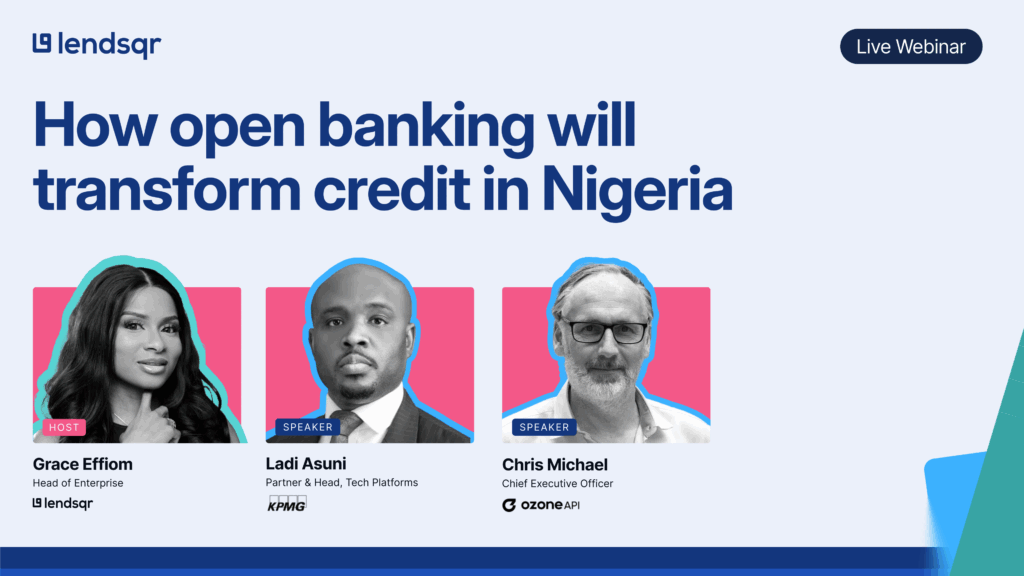
We had a vibrant turnout at our recent webinar, “How Open Banking will transform Credit in Nigeria,” with dozens of questions from professionals across banking, fintech, and policy. Below is a detailed Q&A covering everything from payments and privacy to infrastructure and cross-border insights. Whether you missed the session or want to dive deeper, here’s your chance to explore.
🏦 Do we have the infrastructures in Nigeria, especially in the settlement layer with NIBSS?
Yes. Nigeria already has solid real-time payment rails with NIBSS Instant Payments (NIP) and NQR. These can serve as the foundation for payment initiation services (PIS) in open banking. Banks simply need to expose compliant APIs that plug into those existing rails.
💡 How does open banking benefit lenders in Nigeria practically?
Open banking allows lenders to access real-time customer data (with consent), enabling smarter credit scoring, faster onboarding, and flexible repayment. It reduces reliance on outdated credit reports and enables new models like income-based lending and dynamic collections.
🔐 What safeguards are being considered to ensure data privacy?
Safeguards include regulated licensing of fintechs, secure OAuth2.0 authentication, customer-controlled consent, and compliance with Nigeria’s Data Protection Regulation (NDPR). Customers decide what data to share, for how long, and with whom.
🛡️ How can we curb abuses and align with international best practices?
By enforcing strict accreditation for third-party providers (TPPs), implementing regular audits, and ensuring APIs follow global security standards (e.g., FAPI, ISO 27001). Countries like the UK and UAE show that pairing regulation with commercial incentives creates a trusted ecosystem.
📊 How will open banking be more effective than traditional credit bureaus for lenders?
Credit bureaus provide historical, often delayed data. Open banking gives lenders real-time visibility into income patterns, spending habits, and account activity—especially helpful for thin-file or informal customers not fully captured by bureaus.
🌍 How is open banking shaping up in the UAE? How does it compare to the UK and Nigeria?
The UAE has adopted a centralized open finance framework, extending beyond banking to include insurance, pensions, and telecom. The UK led with a regulatory mandate focused on banking APIs. Nigeria is pursuing a hybrid model—regulatory foundation with room for market-driven adoption.
💳 Is credit a major feature of open banking in the UAE too?
Yes. In the UAE, open finance powers real-time income verification, automated loan underwriting, and even usage-based insurance. Fintechs are using it to build credit products tailored to expatriates, freelancers, and SMEs.
🧾 Do you see open banking overtaking cards and virtual accounts in Nigeria?
Ladi Asuni: Not immediately, but it will complement them. Payment Initiation Services (PIS) are faster and cheaper, especially for collections and e-commerce. For small merchants and lenders, this could reduce fees and increase collection efficiency.
📅 Are there incentives or mandatory deadlines for banks?
Yes. The CBN mandates that banks must publish AIS and PIS endpoints by August 2025. While there’s no direct financial incentive, banks can monetize PIS calls, creating commercial sustainability for API investment.
🔗 What is the role of Account Aggregators (AA), and how can Nigeria learn from India?
In India, AAs act as data intermediaries. In Nigeria, if a unified API standard is adopted across banks, AAs may be less critical. However, AAs could still add value by aggregating data from insurers, pension funds, and investment firms.
💰 What commercial models drive sustainability and innovation?
Popular models include: tiered pricing for PIS APIs, subscription plans for premium data, revenue sharing for referrals, and freemium access to basic AIS. A balance of access and monetization encourages adoption and innovation.
⚙️ How can we achieve standardization across outdated legacy banking systems?
Through enforced API specifications, shared developer toolkits, centralized testing labs, and co-funding for core upgrades. Sandboxes, sample schemas, and reference implementations can help banks upgrade incrementally.
📥 How is open banking better than direct debit mandates for collections?
Open banking collections are more dynamic. Lenders can check balances in real time, initiate payments with customer consent, and retry intelligently—reducing failed debits and improving borrower experience.
🔍 How is open banking building trust and reducing complexity?
It introduces transparent consent processes, regulated third parties, and secure API standards. Technical complexity is addressed with shared libraries, PKI support, and step-by-step rollout strategies.
🛑 What boundaries are in place to protect consumer privacy?
Customers must opt in explicitly and can revoke access anytime. Fintechs are bound by NDPR and CBN licensing. Only necessary data is shared, and all access is logged and audited.
📨 Can we get the webinar recording?
Yes! A link will be sent to all registrants. If you didn’t receive it, please contact [email protected].
💼 How will open banking affect non-bank financial services (investments, pensions, insurance)?
As we move to open finance, these sectors will benefit from real-time data access. Expect smarter pension top-ups, insurance underwriting based on actual usage, and investment advice tailored to cash flow patterns.
Obtaining an FCA consumer credit license is a key step for businesses that want to offer loans, credit cards, BNPL, or other consumer credit products in the UK. This guide explains who needs FCA authorization, the application process, eligibility requirements, expected costs, and practical tips to help lenders navigate the licensing process successfully.
If you’re a non-profit or development finance institution (DFI), it should be easier to run a lending program if you're already doing the hard part of reaching people most others won’t.
The end-to-end loan management software that’s rewriting the rules for lenders globally by offering enterprise-grade features without the enterprise-grade costs.
September 30, 2024
Make Better Informed Decisions
Our decision model Oraculi helps you handle all modules required to form the decision model for your lending business, convenient and
easy.