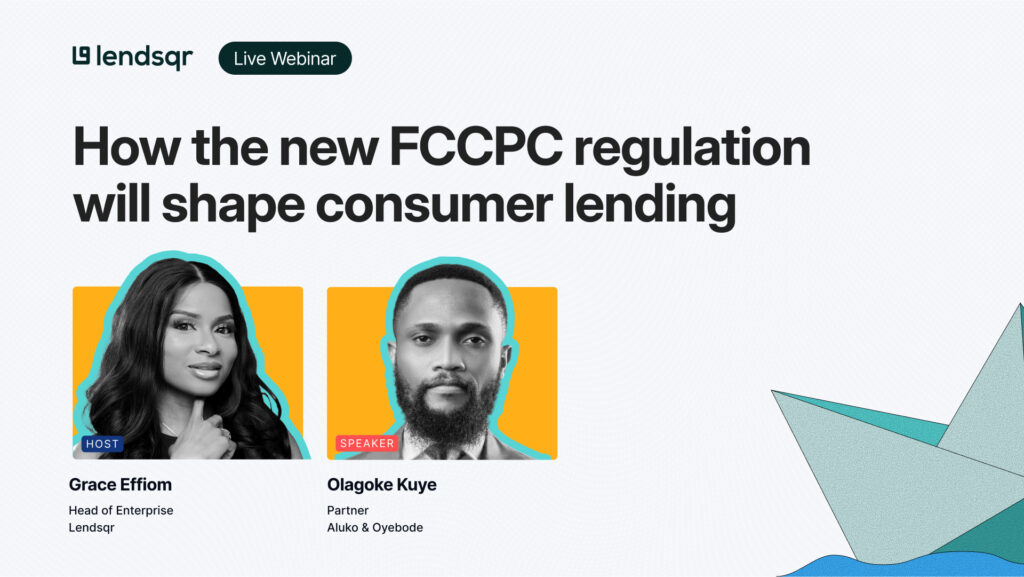
How the New FCCPC Regulation Will Shape Consumer Lending: Audience Q&A
Back
Lendsqr webinar
How the New FCCPC Regulation Will Shape Consumer Lending: Audience Q&A
Last updated September 18, 2025
Theresa Sunday
In this post
Share
We had a vibrant turnout at our recent webinar, “How the New FCCPC Regulation Will Shape Consumer Lending,” with professionals from banks, fintechs, microfinance institutions, cooperative societies, and digital lenders joining us to unpack how Nigeria’s updated consumer-credit rules will impact their businesses. Below is a detailed Q&A capturing the highlights, from compliance and licensing to data privacy, collections, and dispute resolution.
What is the scope of the new FCCPC regulation?
The new framework consolidates consumer-credit oversight under the FCCPC, introducing standardized licensing, disclosure rules, fair-lending principles, and stronger enforcement powers. It applies to banks, traditional lenders (such as cooperatives and MFIs), digital lenders, BNPL players, and loan apps.
Who is referred to as “traditional lenders”?
In the context of the FCCPC regulation, traditional lenders are credit providers operating under legacy or non-digital models. They typically rely on in-branch operations, paper-based contracts, or long-standing regulatory frameworks. The FCCPC rules bring these lenders to the same transparency and consumer-protection standards as fully digital lenders and loan apps.
How will disclosure and transparency requirements change?
All lenders, banks, MFIs, cooperative societies, and loan apps must provide clear, pre-contract information: interest rates, fees, repayment schedules, and consequences of default in plain language. Digital loan apps will have to display the total cost of credit upfront and obtain documented consent before disbursing.
How does this affect traditional lenders compared to digital lenders?
Traditional lenders (commercial banks, MFIs, cooperatives) often relied on legacy contracts and informal disclosures. Under the new regime, they must digitize disclosures, log consent, and publish APRs just like fintechs. Banks are also expected to strengthen their complaints-handling units and adopt the FCCPC’s standard templates.
How will consumer protection and privacy be enforced?
The FCCPC mandates secure handling of customer data, in line with the NDPR. Lenders must limit data collection to what’s necessary, obtain explicit consent, and maintain audit trails. Breaches carry heavier penalties, and repeat offenders risk suspension.
How will collections and debt-recovery practices be affected?
Aggressive or abusive collection tactics (public shaming, unauthorized contact of relatives, etc.) are now explicitly prohibited for all lenders, including traditional institutions. Lenders must follow an approved debt-collection code of conduct, provide repayment-plan options, and use only FCCPC-registered agents.
Will the regulation affect loan pricing?
Yes. While it doesn’t cap rates, it requires lenders to disclose the Annual Percentage Rate (APR) and prohibits hidden charges. Over time, this transparency is expected to drive competitive pricing and better customer outcomes for both traditional and digital borrowers.
How does this interact with other regulators (CBN, NDIC)?
The FCCPC works alongside the CBN and NDIC to avoid regulatory overlap. For example, prudential requirements (capital adequacy) remain with the CBN, but consumer-protection matters (disclosure, privacy, collections) are FCCPC-led.
What are the compliance timelines?
Existing lenders—banks, cooperatives, MFIs, fintechs—have 6–12 months (depending on category) to align with the new rules. New entrants must comply before launching. The FCCPC will issue phased guidelines, sample templates, and a self-assessment toolkit.
What opportunities does this create for lenders?
Compliant lenders (including traditional ones) can build trust, attract institutional funding, and partner with global platforms. The regulation also opens doors for credit-education products, dispute-resolution services, and standardized digital-loan disclosures.
How should lenders prepare internally?
Conduct a gap analysis of current contracts and disclosures
Train staff on new collection rules
Upgrade systems to log consent and manage data privacy
Engage legal counsel early to review loan agreements
Set up a complaint-handling unit that meets FCCPC standards
Can we get the webinar recording?
Yes! All registrants will receive the recording link. If you didn’t receive it, please contact [email protected].
Obtaining an FCA consumer credit license is a key step for businesses that want to offer loans, credit cards, BNPL, or other consumer credit products in the UK. This guide explains who needs FCA authorization, the application process, eligibility requirements, expected costs, and practical tips to help lenders navigate the licensing process successfully.
If you’re a non-profit or development finance institution (DFI), it should be easier to run a lending program if you're already doing the hard part of reaching people most others won’t.
The end-to-end loan management software that’s rewriting the rules for lenders globally by offering enterprise-grade features without the enterprise-grade costs.
September 30, 2024
Make Better Informed Decisions
Our decision model Oraculi helps you handle all modules required to form the decision model for your lending business, convenient and
easy.