Key Takeaways from the Q&A Session on FCCPC, DEON-CL, GSI, and the Future of Consumer Credit
Back
Lendsqr webinar
Key Takeaways from the Q&A Session on FCCPC, DEON-CL, GSI, and the Future of Consumer Credit
Last updated December 1, 2025
Dara
In this post
Share
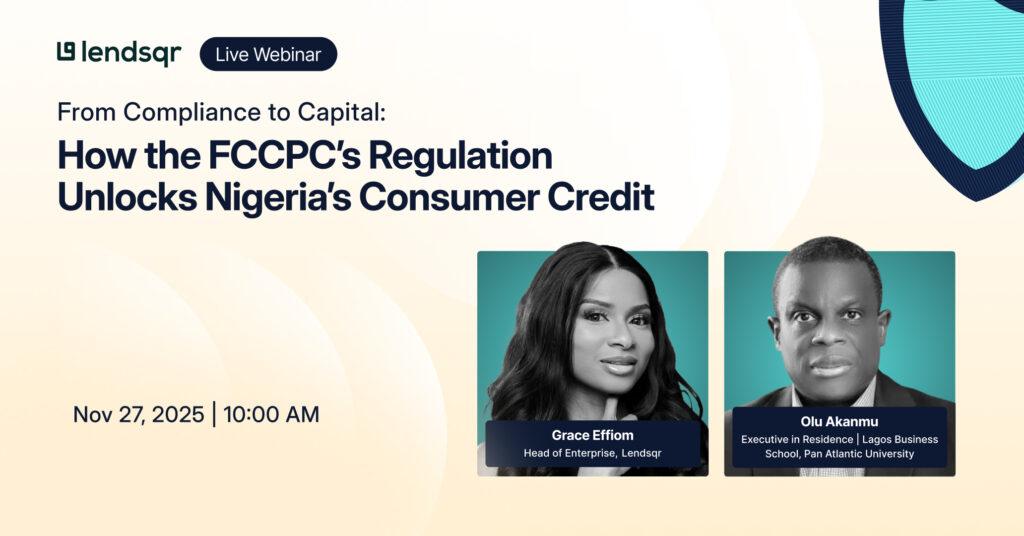
The audience Q&A at the From Compliance to Capital webinar turned out to be one of the most revealing parts of the entire conversation. While the main session focused on the structure and opportunity that regulation brings, the Q&A clarified the industry’s real fears: inflation risk, costs, crowding out, GSI delays, market fairness, and what the future might look like for digital lenders of all sizes.
Here is a deep dive into the themes that shaped the discussion and what lenders should take away from them.
Will an overabundance of credit cause Inflation?
A common fear in developing economies is that expanding credit automatically fuels inflation. Olu dismissed this concern clearly.
The important distinction is what type of credit is expanding.
Consumption loans do little to increase productivity.
Productive credit which includes working capital, equipment financing, inventory financing grows output, jobs, and economic capacity.
When credit increases productive activity, the economy becomes more efficient. More goods and services are created, and inflationary pressure drops. The real risk is not “too much credit,” but “too much shallow, consumption-only credit.”
Nigeria does not have that problem today. Its credit penetration is too low for inflationary expansion to be a threat.
Will institutional investors crowd out small lenders?
FCCPC’s cleanup makes the market more attractive to institutional capital. This raised a real concern: will smaller lenders be pushed out?
Olu argued the opposite.
A structured market does not lead to dangerous concentration. It creates segmentation. Lenders thrive by:
serving different risk tiers
building niche products
innovating with data
targeting distinct customer segments
operating in geographies larger players overlook
Nigeria’s credit demand is far bigger than any set of large players can cover. The market is not moving toward consolidation. It is moving toward specialization, which actually benefits smaller, agile lenders.
Why don’t money lenders have access to GSI?
The audience expressed deep frustration about GSI, especially the lack of access for licensed money lenders.
Olu explained that GSI access is not blocked by regulation. The gap exists because the industry is fragmented.
Banks have access because they negotiate as a unified association. Money lenders act individually, so they do not have the collective bargaining strength needed to secure integration.
His advice was clear: The moment lenders organize and push for access as one voice, the conversation changes. Regulators respond to structured associations, not scattered individual requests.
Could DEON-CL create market concentration and reduce innovation?
Regulation always brings the fear that bigger players will benefit disproportionately.
Olu’s view was practical: DEON-CL brings order, not concentration. Rules level the playing field, because:
nobody can hide behind anonymous apps
everyone must report to the credit bureau
complaints are traceable
partnerships must be fair
reputational abuse becomes impossible
onboarding and lending become more transparent
Innovation does not die under regulation. Innovation dies under chaos. DEON-CL creates the structure that innovation needs to thrive safely.
What adjustment would strengthen DEON-CL the most?
Olu recommended one major improvement: More clarity and alignment between FCCPC rules and CBN systems.
Things like:
streamlined identity reconciliation
unified digital onboarding standards
cleaner pathways into GSI
clearer operational guidance for digital lenders
Aligning regulatory frameworks reduces confusion and helps both small and large lenders execute more confidently.
Will Credit Bureau fees push lending costs higher?
A lender asked whether mandatory bureau reporting would make loans more expensive for borrowers.
Olu and Grace acknowledged the concern but highlighted two counterpoints:
Bureau data reduces overall default risk. Lower risk ultimately reduces interest rates over time.
Collective bargaining brings down bureau pricing. Grace gave a concrete example: Lendsqr negotiated significantly reduced bureau fees for lenders once they were aggregated on the platform.
Higher transparency now leads to lower costs later. Borrowers benefit when lenders can price accurately instead of padding for uncertainty.
What could Nigeria’s consumer credit landscape look like in 2–3 years?
Olu made a grounded but optimistic prediction:
If today’s regulatory direction holds and lenders embrace DEON responsibly, Nigeria could see:
a more predictable credit market
widespread positive credit histories
fewer harassment scandals
improved repayment behavior
more investors deploying capital
early maturity of productive MSME credit
the first real credit culture in the country
This is a realistic-once-ambitious transformation: Nigeria could move from single-digit credit penetration toward the first stage of broad-based access.
What about the October 2025 deadline for FCCPC certification?
Lenders worried about incomplete documentation and what the deadline means.
The response was straightforward: The requirement remains mandatory, and lenders should resume processing their approvals. The point of the timeline is to ensure everyone operates under the same level of accountability.
If you are behind, now is the time to engage FCCPC not wait.
Why does GSI still feel slow?
A lender expressed frustration that:
“There is nobody protecting the lender, while everyone protects the borrower.”
Olu empathized and explained that GSI’s slow rollout reflects system complexity, not disregard. Banks dominate the process because they have a unified body and the technical infrastructure to integrate.
Money lenders need:
stronger representation
clear alignment with CBN onboarding standards
collective negotiation through an association
Once these elements are in place, GSI implementation accelerates.
What message should founders worried about DEON-CL hear?
Olu’s advice was direct: DEON-CL rewards lenders who are structured, compliant, data-driven, and transparent.
Founders should focus on:
compliance readiness
underwriting innovation
borrower education
niche focus
strong partnerships
robust data submission
clean customer journeys
Regulation isn’t the enemy of digital lending. It is the foundation that allows serious players to scale safely.
What happens to borrowers trapped by collapsed lending firms?
A painful but important question: What about customers whose lenders have closed shop but left inaccurate debts on the bureau?
The guidance was simple: Borrowers should file a formal dispute with the credit bureau. Bureaus are required to verify the information. If the lender cannot be reached or cannot validate the debt, the bureau must correct or remove the entry after investigation.
Borrowers are not trapped permanently, the dispute process exists for exactly this reason.
Do regulations make borrowers “Kings,” leaving lenders exposed?
Some lenders felt that strict FCCPC rules put all consequences on them while giving borrowers leverage.
Olu reframed the issue: The regulation does not prioritize borrowers over lenders. It prioritizes fairness, traceability, and accountability.
This benefits lenders because:
loan recovery becomes cleaner
onboarding becomes more reliable
identity improves
credit histories become useful
intentional defaulters lose hiding places
illegal apps disappear from the ecosystem
Without structure, lenders carry all the risk. With structure, the risk becomes manageable.
“Please send the recording”
Several attendees requested the replay. You can find that here and it will also be sent to all registered attendees.
Final thoughts
The Q&A session revealed the real heartbeat of the industry hopes, fears, frustrations, and opportunities. Across every concern, one theme kept reappearing:
Structure does not kill credit. Structure unlocks credit.
Obtaining an FCA consumer credit license is a key step for businesses that want to offer loans, credit cards, BNPL, or other consumer credit products in the UK. This guide explains who needs FCA authorization, the application process, eligibility requirements, expected costs, and practical tips to help lenders navigate the licensing process successfully.
If you’re a non-profit or development finance institution (DFI), it should be easier to run a lending program if you're already doing the hard part of reaching people most others won’t.
The end-to-end loan management software that’s rewriting the rules for lenders globally by offering enterprise-grade features without the enterprise-grade costs.
September 30, 2024
Make Better Informed Decisions
Our decision model Oraculi helps you handle all modules required to form the decision model for your lending business, convenient and
easy.