Top loan origination systems worth considering in 2026
Back
Lender information
Top loan origination systems worth considering in 2026
Last updated July 27, 2026
Dara
In this post
Share
In 2026, loan origination systems (LOS) are one of the sharpest differentiators between lenders that grow and lenders that stall. The speed, accuracy, and transparency of how a loan moves from application to approval directly builds borrower trust and long-term profitability. A system that can’t keep up with regulatory demands, borrower expectations, or competition is a liability.
Borrower data now includes rental history and alternative credit signals. Regulators are reforming long-standing scoring models. AI-driven underwriting is central. This means a good LOS simply rethinks the entire lending pipeline. Lenders who recognize this are are positioning themselves to capture entirely new segments of the market.
The following analysis looks at the systems transforming that space. It also considers other factors, from deployment choices to compliance readiness, that will determine whether a platform is a strategic asset or a future headache.
A loan origination system, or LOS, is software that manages the entire lending process from start to finish. It takes care of everything, starting with the borrower’s application, moving through underwriting and approval, and ending with documentation and disbursement. Instead of relying on paperwork and disconnected systems, lenders now use these platforms to keep the whole process simplified and organized.
What makes modern LOS platforms valuable is how much they automate. They run credit checks, screen for fraud, and make sure every loan follows the right regulatory requirements. This automation reduces errors and cuts down on delays, which makes both lenders and borrowers more confident in the process.
In 2026, many of these systems are hosted in the cloud, which means they can grow with the lender’s needs, be accessed remotely, and connect easily to external services like credit bureaus or payment gateways. This flexibility makes it easier for lenders to adapt to changing borrower expectations and shifting compliance standards without heavy IT infrastructure.
The advantages show up quickly: loans move through the pipeline faster, communication with borrowers improves through automated updates, and operational costs drop because there’s less manual work. At the same time, compliance becomes easier to manage and risks are better controlled. For lenders, an LOS is a core system that supports efficiency, innovation, and a more positive borrower experience.
Criteria for selecting the best loan origination system in 2026
Choosing the right LOS comes down to aligning the platform with a lender’s lending model, growth plans, and compliance obligations. Below are the key factors that matter most:
Complete loan lifecycle coverage
A strong loan origination system should manage every stage of the lending journey in one place. That means handling intake, borrower verification, underwriting, compliance checks, documentation, disbursement, and ongoing servicing. If even one of these steps is missing, lenders end up relying on manual processes or third-party tools, which slows operations and increases costs.
Having the full lifecycle under a single system ensures that data flows without interruption. This reduces the risk of errors from duplicate entries or missing information and creates a central record that both staff and borrowers can rely on. It also minimizes delays, which is important in a competitive lending market where speed and accuracy drive customer trust.
Beyond efficiency, end-to-end coverage provides consistency across departments. This alignment strengthens collaboration internally and improves service externally.
Modern lending requires systems that take repetitive work off the table. Automation within an LOS can handle tasks like verifying documents, routing applications, and applying credit policies. By reducing manual intervention, staff are freed to focus on higher-level decisions, while borrowers benefit from faster turnaround times.
Artificial intelligence adds further depth by analyzing borrower behavior, alternative credit data, and historical trends. It can identify risk patterns more accurately than manual reviews, which leads to smarter lending decisions. AI can also personalize loan offers, aligning terms with a borrower’s specific profile rather than applying an all-in-one standard.
Together, automation and AI reduce human error, increase efficiency, and build more customized borrower experiences. They also allow lenders to scale their operations without proportionally increasing staff, making them essential for long-term growth.
Compliance and data security
Regulatory compliance is non-negotiable in lending. A capable LOS must be designed with built-in features that keep lenders aligned with current laws and adapt quickly to new ones. Automated compliance checks and audit trails reduce the risk of costly violations and save time during reviews or examinations.
Equally important is security. Borrowers trust lenders with sensitive personal and financial data, and that trust must be protected at all times. Systems should enforce strong encryption, multi-layered authentication, and role-based access to limit exposure. These protections safeguard against external breaches and internal misuse.
In practice, compliance and security go hand in hand. A lender that falls short in either area risks financial penalties, reputational damage, and erosion of borrower confidence. An LOS that prioritizes both ensures stability and trustworthiness in a rapidly evolving environment.
Scalability and flexibility
Lenders don’t operate at a fixed volume forever. An LOS must scale seamlessly to support higher application volumes without slowing down or requiring an overhaul. Lenders processing a few thousand loans today may be managing millions tomorrow, and the system should grow with them.
Flexibility is equally important. Lending products vary widely, and lenders need tools that allow them to customize workflows, approval criteria, and documentation. A rigid system limits innovation and forces lenders into costly workarounds when they want to expand or adjust their offerings.
When scalability and flexibility are built in, lenders gain room to evolve. They can respond to new regulations, adjusting borrower expectations, or up-coming markets quickly and cost-effectively, keeping them ahead of competitors bound by outdated systems.
Integration with external systems
A loan doesn’t exist in isolation, it connects to credit bureaus, payment processors, core banking systems, and customer relationship tools. An LOS should integrate with these external platforms smoothly, reducing the need for manual data transfers.
The best systems achieve this through open APIs and pre-built connectors. These tools make it easier to plug into existing infrastructure without requiring extensive customization. Integration creates a more connected ecosystem where every part of the lending journey is visible in one place.
When integrations are strong, lenders benefit from real-time data, faster decision-making, and fewer errors. Borrowers benefit too, with smoother processes and quicker access to funds. Integration is a necessity for delivering a seamless lending experience.
Deployment options
Not all lenders share the same infrastructure or risk appetite. Cloud-hosted LOS platforms offer scalability, remote access, and reduced IT overhead, making them popular among fintechs and forward-leaning lenders. On-premises deployments, by contrast, give lenders more control and may align better with stricter data policies. Hybrid approaches combine both, offering flexibility to balance cost efficiency with compliance needs.
The choice of deployment has long-term implications for operations and strategy. Cloud deployments make scaling easier, but they rely on vendor reliability and internet connectivity. On-premises deployments may offer security advantages but often come with higher costs and maintenance burdens.
The key is to match the deployment model to the lender’s goals, resources, and regulatory environment. A good LOS won’t force lenders into one option, it will support whichever path aligns best with their business strategy.
User experience
Even the most advanced system fails if it isn’t usable. For staff, an intuitive interface shortens training time, reduces errors, and makes day-to-day tasks more efficient. Complex, cluttered systems often push employees toward workarounds, undermining the very efficiency gains the system is meant to deliver.
For borrowers, the experience is equally important. Mobile-friendly applications, real-time updates, and multi-channel support create a smoother journey from application to approval. In a competitive lending market, small friction points can drive borrowers to competitors.
User experience is often underestimated, but it directly impacts adoption and satisfaction. A lender that prioritizes ease of use for both staff and borrowers ensures stronger engagement, faster processes, and higher overall trust in the system.
Leading loan origination systems to consider
With many loan origination systems on the market, the challenge is knowing which ones are worth your time. The best platforms stand out for their ability to simplify workflows, cut down approval times, and adapt as your lending needs grow. Here are the top leading LOS systems in 2026:
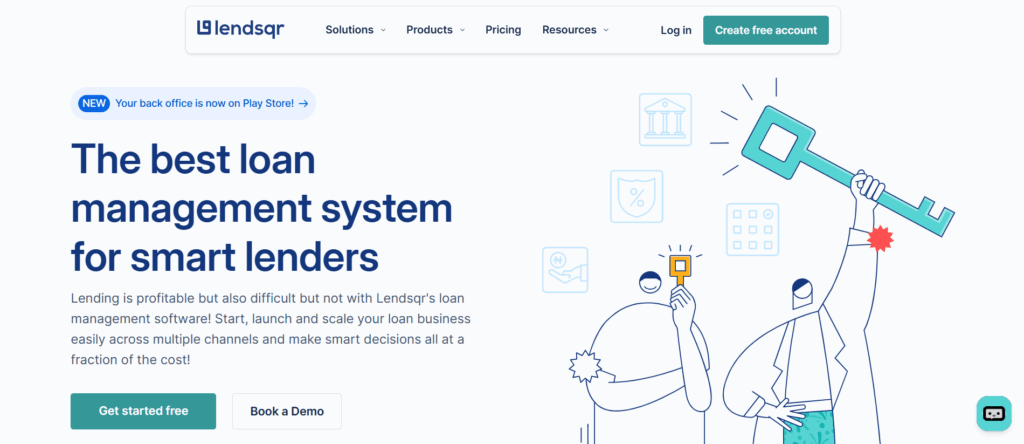
Lendsqr is a Lending-as-a-Service platform that supports institutions like banks, fintechs, and micro-lenders through the full digital lending workflow; from origination to collection and recovery. It offers flexible subscription plans, including a free tier with decision models and disbursement tools, and paid plans that add features like customization, mobile apps, referrals, savings modules, and white-label options.
The platform supports multi-channel origination through web, customizable mobile and back-office apps, accompanied by APIs for integration and rapid deployment. Its design emphasizes automation, configurable loan products, and analytics, making it a scalable and cost-effective choice for lenders aiming to launch or expand lending with minimal friction.
LendFusion
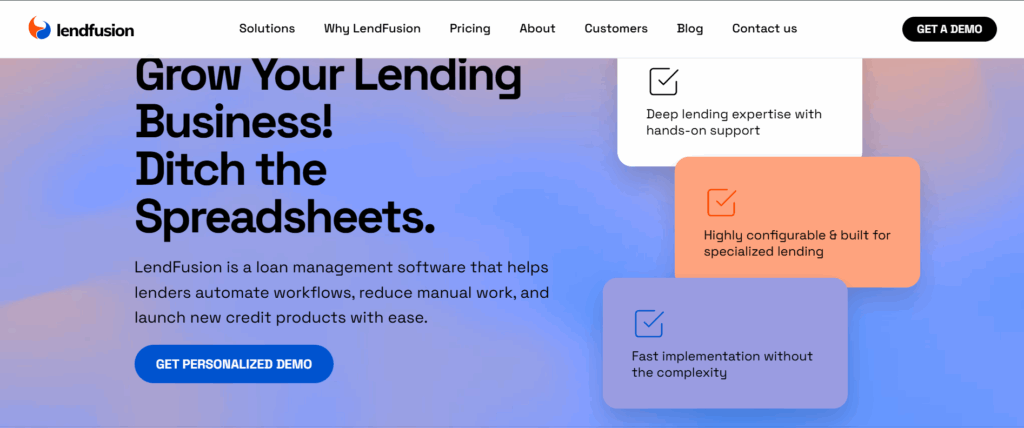
LendFusion is built for lenders who want speed and flexibility without the weight of complex systems. It can be set up in less than three months and comes with strong workflow automation, compliance features, and analytics. Its infrastructure is EU-hosted and fully GDPR-compliant, making it a safe choice for lenders operating under strict data rules.
It’s especially well-suited for lenders handling £10M to £100M in loan volumes who need customization but don’t want to sacrifice simplicity. By combining fast deployment with customized workflows, it helps lenders scale while maintaining accuracy and regulatory confidence.
HES FinTech
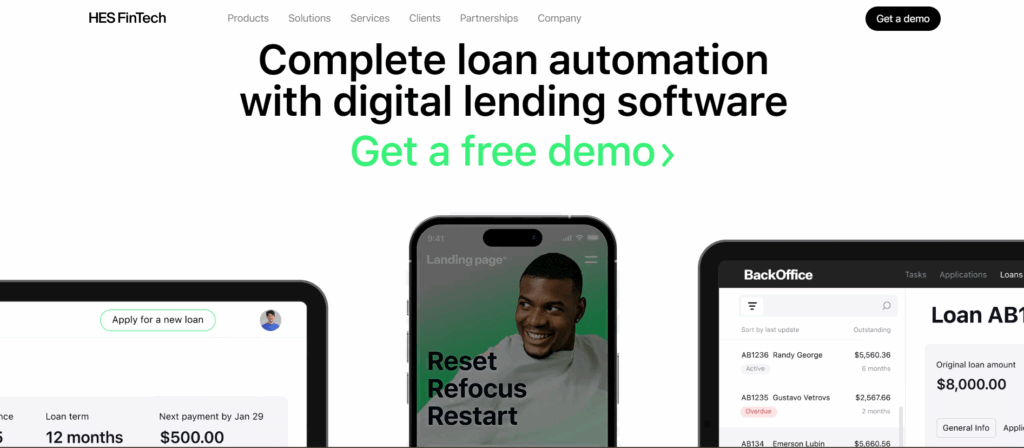
HES FinTech is a modular platform that covers the full lending process across multiple product types, from SME loans to leasing and BNPL. Its flexibility allows lenders to pick and choose the tools they need while supporting end-to-end automation. The system is designed for speed, with white-label options that let lenders launch new offerings under their own brand.
Its strength lies in adaptability. For lenders introducing niche or specialized loan products, HES makes it easier to configure workflows and bring them to market quickly, without being tied to rigid, pre-built systems.
TurnKey lender
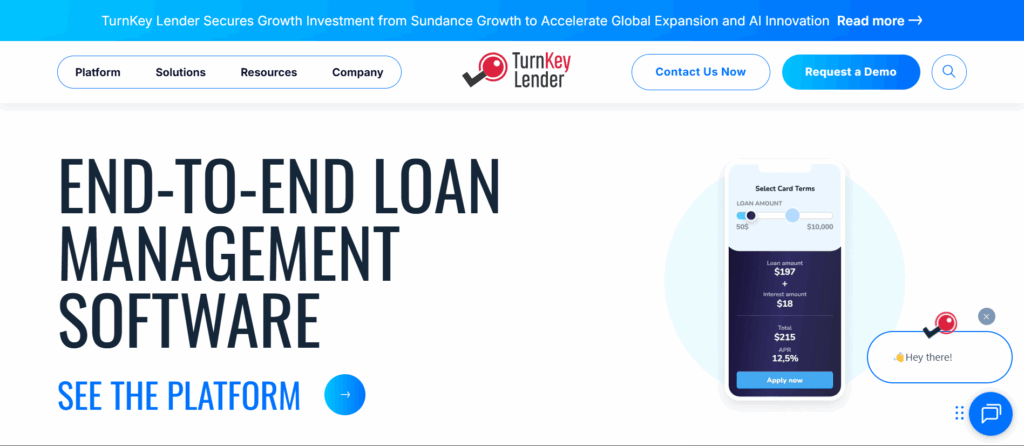
TurnKey Lender is an AI-powered, cloud-based lending automation platform used globally by lenders across consumer, SME, and commercial segments. It automates every part of the lending process from application to servicing, debt collection, and reporting, using deep neural networks and machine learning to deliver fast, accurate credit decisioning.
The system is modular and highly customizable, with pre-built workflows and scoring engines that can be adapted across loan types, including auto and payday to medical, BNPL, and leasing. It can be deployed quickly, supported by flexible deployment modes (cloud or on-prem), dashboards for full visibility, and built-in compliance tools for global standards.
Finflux by M2P
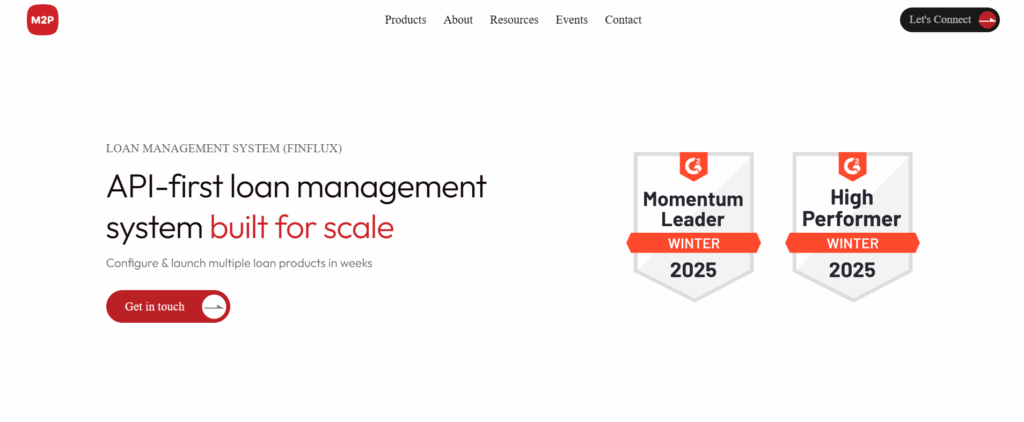
Finflux is designed to support a wide spectrum of lending, from microfinance to SME credit. Its standout feature is a low-code business rules engine, which allows lenders to configure loan policies and workflows with minimal technical effort. The platform also integrates with over 60 third-party systems, giving lenders a connected ecosystem out of the box.
Operational efficiency is a key advantage here. Automated borrower notifications, simplified onboarding, and smooth integrations help lenders cut manual work while keeping customers engaged throughout the process.
Loandisk
LoanDisk is a cloud-native loan management system designed for microfinance institutions, credit unions, and small to mid-sized lenders. It supports the full loan lifecycle; application and approval to repayments and reporting, offering features like automated SMS/email reminders, customizable loan products, and real-time dashboards to monitor performance.
The platform makes loan tracking and portfolio oversight intuitive, with tools for fee setup, collateral tracking, bulk messaging, and financial reporting, all via a user-friendly interface. It’s particularly effective at reducing operational overhead while improving clarity and efficiency for mid-sized lenders.
Zeitro
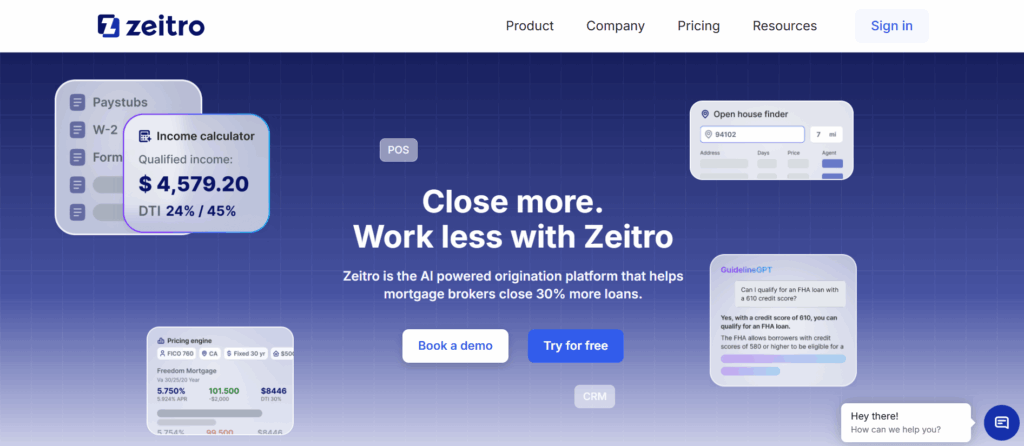
Zeitro takes an AI-first approach to mortgage origination, using tools like GuidelineGPT to simplify underwriting and decision-making. It manages the full mortgage workflow, from lead generation through underwriting, helping lenders increase both speed and capacity.
The platform is designed to improve completion rates by reducing friction in the process. With AI powering key steps, lenders can handle more applications simultaneously while maintaining accuracy, making it an attractive option for lenders focused on scaling mortgage operations.
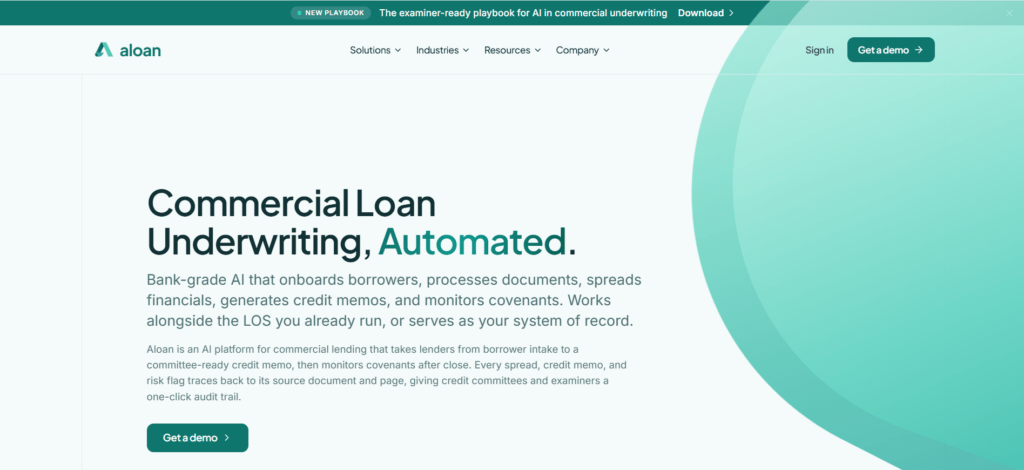
Aloan
Aloan is an AI-native commercial loan underwriting platform built for U.S. community banks, credit unions, and commercial lenders, typically those with between $500 million and $25 billion in assets.
Rather than replacing a lender’s existing loan origination system, it runs alongside it, using AI to handle document collection and classification, financial spreading with cross-entity K-1 tracing, automated risk flagging, and credit memo generation, with every extracted figure traceable back to its exact source document and page.
Its main strength is speed without a system migration. Lenders can go from submitted documents to a complete, committee-ready credit memo in under 30 minutes, with reported gains of up to 9x underwriting throughput and 99.3% data extraction accuracy.
Aloan connects to a lender’s existing origination system and core banking platform through REST APIs and webhooks, and it can also serve as a lender’s system of record for those without an incumbent LOS.
Because deployment typically takes days to weeks rather than months, it’s positioned for institutions that want to compress underwriting turnaround and build an examiner-ready audit trail without the cost and disruption of a full loan origination system replacement.
The platform covers SBA, commercial real estate, C&I, and equipment finance lending, and it holds SOC 2 Type II certification. It was built by a team with prior engineering experience at Google, Apple, Meta, and X.
How to implement a loan origination system successfully
Prior to adopting a loan origination system in your business, make sure the platform fits your goals, integrates smoothly with your processes, and is embraced by the people who use it every day. A thoughtful approach can mean the difference between a costly misstep and business advantage. Below is how you can implement LOS successfully:
Set clear goals: Before introducing the system, align it with your business objectives. Break implementation into smaller stages so operations aren’t disrupted, and the team can adjust gradually.
Train and involve staff: A system is only as effective as the people using it. Provide practical training and engage staff early so they understand how the LOS makes their work easier, leading to faster adoption.
Test integrations thoroughly: The LOS must work easily with your core banking system, credit bureaus, and any third-party services. Run detailed integration tests to avoid issues or data errors after launch.
Monitor and refine continuously: After going live, track loan performance and listen to user feedback. Use this information to tweak configurations, fix pain points, and improve efficiency over time.
Technology doesn’t erase the complexity of lending; it simply transforms how lenders handle it. A loan origination system is not a magic switch. It is a framework that requires discipline, adaptation, and trust in structured processes. What matters is how lenders align the system with their goals; reducing bias in approvals, tightening compliance, and making borrower interactions more about clarity.
The advantage lies in how quickly a lender can learn, refine, and scale once the system is in place. Those who treat implementation as an ongoing practice, rather than a one-time project, will see lending evolve from being reactive to strategic.
Obtaining an FCA consumer credit license is a key step for businesses that want to offer loans, credit cards, BNPL, or other consumer credit products in the UK. This guide explains who needs FCA authorization, the application process, eligibility requirements, expected costs, and practical tips to help lenders navigate the licensing process successfully.
If you’re a non-profit or development finance institution (DFI), it should be easier to run a lending program if you're already doing the hard part of reaching people most others won’t.
The end-to-end loan management software that’s rewriting the rules for lenders globally by offering enterprise-grade features without the enterprise-grade costs.
September 30, 2024
Make Better Informed Decisions
Our decision model Oraculi helps you handle all modules required to form the decision model for your lending business, convenient and
easy.