Right now, your bank holds all your financial data: how much you earn, what you spend, your loan history, and more. But they don’t share that information with anyone, not even with apps that could help you manage money better or get a better loan deal.
Open Banking changes that. It gives you, the customer, control over your own data. With your permission, your financial info can be safely shared with trusted apps, fintechs, or even other banks. Think of it like giving access to your Spotify playlists so a new app can recommend better music. Now replace music with money decisions.
And why should anyone in Africa care? Because Open Banking could mean:
- Cheaper, faster loans for business owners.
- Apps that actually understand your spending habits and help you save.
- Less paperwork and waiting around when applying for credit.
- More competition among banks and lenders, which means better services.
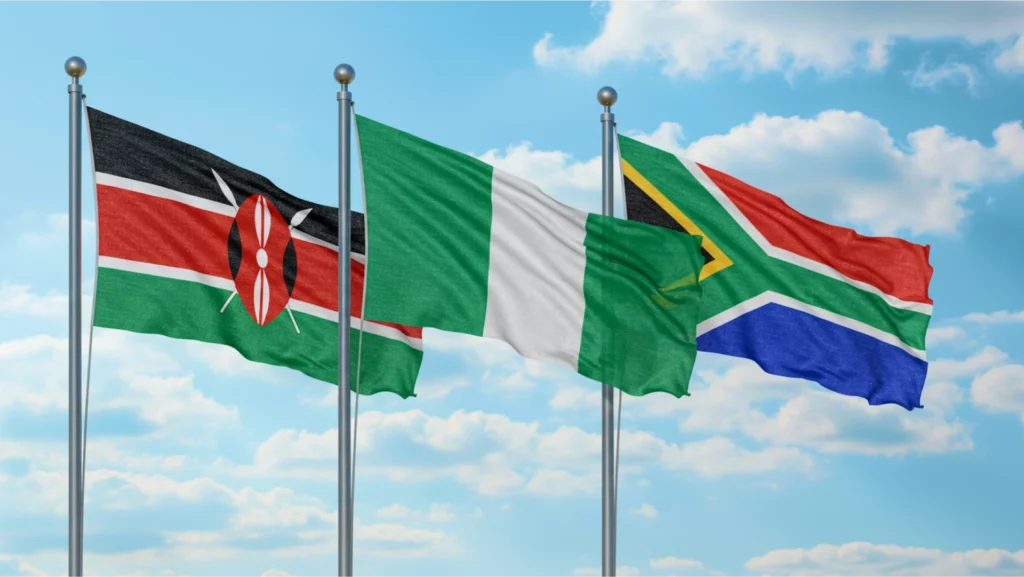
If you’ve ever had to print out a six-month bank statement just to get a ₦100k or R1,000 loan, you already get why Open Banking matters. Now, let’s talk about the three African countries taking real steps forward.
Also read: How to use Mifos X and Apache Fineract with Lendsqr as a core banking system
🇳🇬 Nigeria: Africa’s first to go live
What’s happening on the ground?
Nigeria took the lead in Africa when, in March 2023, the Central Bank of Nigeria (CBN) released official guidelines for Open Banking. This was a big deal, the first clear set of rules letting banks and fintechs share customer data securely and legally. It took Nigeria about eight years to get here, starting from early talks in 2018.
Startups like Paystack (now part of Stripe), Mono, Lendsqr, and OnePipe have been preparing for this moment by building tech that depends on accessing banking data. Traditional banks like Sterling Bank and large audit firms like KPMG and PwC are also part of the early adopters, showing the seriousness of the move.
One key milestone to watch is that Nigeria expects its first live APIs to be up and running by the third quarter of 2025. This will allow third parties to offer services like instant loan approvals or personalized budgeting apps.
Regulatory moves
CBN’s framework is more than guidelines; it’s backed by Nigerian data protection laws ensuring customers stay in control of their data. Banks have to allow approved fintechs to access data but only after customers give clear consent.
Musa Jimoh, Director of Payments Systems Management at CBN, explained:
“Open Banking will foster sharing of customer-permissioned data to build services focused on real needs.”
This regulatory certainty helps reduce risks for fintechs and banks, encouraging innovation while protecting consumers.
Also read: BVN is great, but here are 5 ways CBN can make it better
Challenges
Challenges remain. Some traditional banks have been slow to fully embrace Open Banking, fearing loss of control or increased security risks. Also, many Nigerians remain cautious about sharing financial data, often due to low digital literacy or trust issues.
Adedeji Olowe, founder of Lendsqr and Open Banking Nigeria trustee, puts it in perspective:
“There’s no point talking about savings tools when there’s no money to save. The most immediate need is affordable, responsible lending.”
He sees Open Banking as key to enabling lenders to better understand customers, reducing risks and expanding access to credit. Olowe also believes it will help build a “subscription economy” in Nigeria, where businesses can offer services paid for regularly and predictably, a big boost for cash flow management and business growth.
Internet infrastructure is another hindrance. While smartphone use is growing fast, many parts of Nigeria still struggle with reliable internet, something that must improve for Open Banking to reach everyone.
🇰🇪 Kenya: Building on mobile money success
What’s happening on the ground?
Kenya is famous for M-Pesa, the mobile money service that reformed payments across Africa. Now, Kenya is aiming to extend this success into Open Banking. Unlike Nigeria, Kenya’s Central Bank (CBK) hasn’t yet passed official Open Banking laws but is actively preparing the environment.
CBK follows the European PSD2 model, which focuses on secure data sharing with strong consumer protections. Kenyan fintechs and banks have started experimenting with Open Banking principles through partnerships and pilot projects.
The government’s “Kenya National Payments System Vision and Strategy 2021–2025” reflects a clear commitment to Open Banking and API standards. It aims to make payments and financial services work better together across banks, fintechs, SACCOs (Savings and Credit Cooperatives), and money remittance providers.
Regulatory moves
While Kenya’s Open Banking framework is still in development, the CBK is pushing for API standards and data portability. This means making it easier for customers to move their financial data between providers, helpful when switching banks or using different services.
CBK’s goal is to support Kenya’s ambition to become a digital, cash-lite, and 24/7 economy, building on its leadership in mobile money innovation. The regulator is working closely with industry players, including the Kenya Bankers Association and fintechs, to create standards that protect users without blocking innovation.
Challenges
Kenya has an advantage in mobile money awareness but Open Banking is a new level of complexity. It depends more on smartphones, stable internet, and robust digital ID systems.
Many Kenyans are still wary of sharing financial data online, so education and trust-building are crucial. The country also faces infrastructure gaps outside urban areas that could slow adoption.
That said, Kenya’s fintech scene is vibrant enough, so it’s likely that once regulations solidify, new Open Banking services will emerge quickly.
🇿🇦 South Africa: Taking a cautious but steady approach
What’s happening on the ground?
South Africa’s financial sector is mature and complex. It has been exploring Open Banking since 2020, when the South African Reserve Bank (SARB) published a consultation paper seeking public feedback on proposed rules.
While no official regulations are finalized yet, South African banks such as Absa, First National Bank, Standard Bank, and Nedbank have already opened up their systems to some third-party providers, applying Open Banking ideas on their own.
In early 2024, South Africa launched PayShap, a new real-time payment platform aimed at speeding up small transactions between banks. It’s part of a wider push by SARB and industry groups to modernize payments and prepare for Open Banking.
Regulatory moves
South Africa’s regulators, including the Financial Sector Conduct Authority (FSCA), support Open Banking and believe it will benefit consumers and the economy. The FSCA favors a mandatory approach to implementation, but some industry players argue for letting the market lead with voluntary standards.
Because South Africa’s banking market is concentrated in a few large banks, it might be easier to coordinate Open Banking efforts compared to more fragmented markets.
Challenges
There is still debate over how quickly to enforce Open Banking rules and how strictly to regulate. While South Africa has better internet and smartphone penetration than many African countries, there are still gaps, especially in rural areas.
Consumers will also need to build trust and understanding of how their data is used.
Also read: What you need to know about Nigeria’s Open Banking
The open banking vision
Across Nigeria, Kenya, and South Africa, we’re beginning to see the open banking vision take shape, each in their own way. Nigeria leads with regulatory clarity and implementation; Kenya with grassroots fintech ingenuity; South Africa with coordinated, deliberate steps. But progress remains uneven, and much of the ecosystem still depends on willingness from banks, enforcement from regulators, and adoption by consumers.
The next 2–3 years will be pivotal. If implementation keeps pace, through standardized APIs, stronger consent frameworks, and better collaboration, Africa could skip several stages of legacy banking and build something more inclusive from the ground up.
But if progress stalls or remains concentrated among just a few large players, we risk repeating old patterns: closed systems, unequal access, and missed opportunities.
The technology is ready. The regulation is maturing. The demand is growing. What comes next depends on whether banks, fintechs, and regulators can stop pulling in different directions and build the future together.