Sarah, a 100 level student walked into a UBA branch on campus to pay her school fees. Immediately she entered, a saleswoman approached her with a form and convinced her to open an account.
3 years later, Palmpay pays a visit to her university for a campaign. There’s an ongoing promo: create an account and get #2,000 free deposited into the account.
She went to a workspace for privacy and to enjoy the coffee cafe, then she found out there’s a discount for Sterling Bank customers. Bank account number 3 was created.
Then, she started a business and wanted to manage her money better, so she created an account with Opay strictly for business operations. The backstories are endless.
Although technically, we can just get by with one account to save all our money in, it still helps to allocate your money into different accounts.
The problem is you have to keep track of multiple passwords, your balances, spending patterns, transaction receipts, bank statements, USSD codes, etc.
Before you know it, you’ve lost track of how much you’re spending every month and how much you actually have because you’re always dipping into any and every one.
Juggling this financial circus can be overwhelming, time-consuming, and, frankly, stressful. So, you have 2 options: abandon the accounts or learn how to manage them from one place like a pro and stay in control of your finances.
We’ll show you why the latter is beneficial.
1. You gain a comprehensive view of your income and expenses from a single dashboard
Financial chaos is the enemy of peace of mind. When your money is scattered across multiple accounts, it’s harder to keep track of money flowing in and going out.
One day you’re out for lunch, you try to login to your savings account but due to network issues, it doesn’t work. So, you use money from your dedicated business account as an alternative thinking you’d replace it later.
Before you know it, you’re mixing money from different accounts together and you can barely keep track of all your transactions anymore.
To make matters worse, your bank doesn’t send you debit alerts in real time so you’re not even sure how much you actually have in your account.
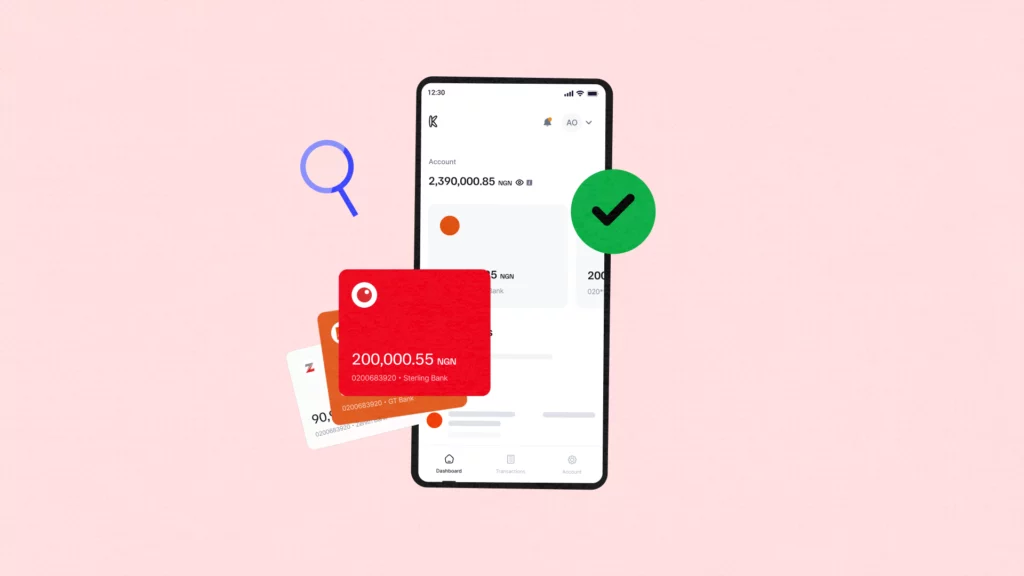
But when you consolidate your financial life into a single dashboard, you get a crystal-clear picture of your income, expenses, and net worth easily without having to do mental math.
2. It simplifies budgeting and helps you plan better
Remember when you created 2 separate savings accounts, one for personal spending and another for your savings, promising yourself that it would help you save better? How’s that working out?
You can barely keep track of money going in and out, how do you plan to budget properly?
When you can see exactly where your money is going, budgeting becomes less of a chore and more of a strategic game plan.
With all your accounts in one place, you can easily categorize your spending, set financial goals, and track your progress. It’s like having a personal finance coach that’s available 24/7.
3. You save time on logging into different accounts and can quickly access all your financial information
Any one with a brain would advise that you have different passwords for your different accounts, and they would be right. But, how many times have you saved yourself from trouble or embarrassment with “Forgot password?” If that option didn’t exist, you’d be left stranded so many times.
Fortunately, with a centralized platform, you only need one password and one email address to access all your financial information. Better, wouldn’t you agree?!
The more accounts you have, the more vulnerable you are to scammers. Especially when you don’t even remember the bank account you created years ago and haven’t used since then.
When your accounts are scattered across different institutions, it’s harder to spot suspicious activity. But, with a centralized platform, you can quickly identify any unusual transactions and take action.
5. Keep track on all your transaction receipts and bank statements
How often do you check your email for your bank statements? Or even keep track of the pile of sms debit alerts you’ve gotten? Do you even know if your bank sends it when it should?
Misplacing or not having a receipt means you have no proof when issues arise and you can’t dispute charges quickly and easily.
But, with one centralized platform, you can have all your receipts from all your bank accounts in one place, searchable and accessible whenever you need them.
But what personal finance management tool offers all these features?
We built Kolo for this specific purpose, to save you from the nightmare of juggling multiple bank accounts. Kolo uses advanced technology, including machine learning, to simplify expense tracking.
Here’s how it works:
Kolo connects to all your data sources, including email and sms
It presents all your bank accounts in an easy to understand, all in one place
If you can’t remember all your bank accounts, Kolo can auto-discover them for you.
You can tag transactions, making it easier to categorize and find them later.
You can also add comments to transactions. If you send money as a birthday gift, you can note that down.
You can see exactly how much you spend in different categories and adjust your budget accordingly.
You can allocate funds to pay off your debts on time and improve your credit score in the process.
Sign up to Kolo and manage your finances like a pro
Managing money isn’t just about keeping it, it’s also about making smart decisions, and using a centralized personal finance management tool is one of the smartest ways to do that.
Sign up today, explore its features, then come back to tell us all about your experience. Your feedback will be greatly appreciated.
Obtaining an FCA consumer credit license is a key step for businesses that want to offer loans, credit cards, BNPL, or other consumer credit products in the UK. This guide explains who needs FCA authorization, the application process, eligibility requirements, expected costs, and practical tips to help lenders navigate the licensing process successfully.
If you’re a non-profit or development finance institution (DFI), it should be easier to run a lending program if you're already doing the hard part of reaching people most others won’t.
The end-to-end loan management software that’s rewriting the rules for lenders globally by offering enterprise-grade features without the enterprise-grade costs.
September 30, 2024
Make Better Informed Decisions
Our decision model Oraculi helps you handle all modules required to form the decision model for your lending business, convenient and
easy.