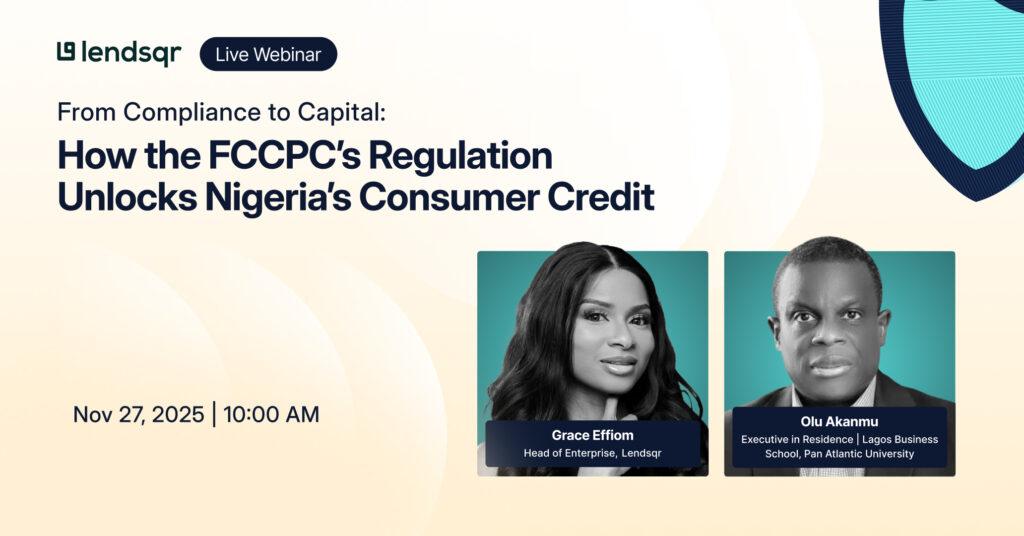
From Compliance to Capital: How the FCCPC’s Regulation Unlocks Nigeria’s Consumer Credit
Back
Lendsqr webinar
From Compliance to Capital: How the FCCPC’s Regulation Unlocks Nigeria’s Consumer Credit
Last updated December 1, 2025
Dara
In this post
Share
A Deep Dive into the Lendsqr Webinar with Olu Akanmu and Grace Effiom (November 27, 2025)
Nigeria’s non-bank lending industry has been reshaped dramatically in the last few years. But for many lenders, the shift from an unregulated environment to a structured FCCPC framework still feels like a burden rather than an opportunity.
The latest Lendsqr webinar, From Compliance to Capital, brought real clarity to this ongoing debate. Hosted by Grace Effiom (Head of Enterprise, Lendsqr) and featuring Olu Akanmu, one of the most experienced leaders across banking, telecoms, and fintech, the session explored how the new regulatory landscape is not just about consumer protection but about unlocking scale, investor confidence, and smarter credit markets.
If you missed it, here is a deeper walkthrough of the most important insights, why they matter, and where to watch them in the recording.
Cleaning up the Chaos: Why regulation became necessary
Timestamps: 00:03:32–00:06:02
Grace opened the conversation with an honest acknowledgment of the past. The years leading up to 2019 were marked by lending apps with unclear ownership, no licensing, no accountability, and in many cases, outright harassment of borrowers. Lenders often operated behind anonymous app labels rather than registered company names, which left borrowers confused, unprotected, and frequently exploited.
Olu described this as a “chaotic market” where neither side had enough information to create trust. Lenders didn’t truly know who they were lending to, borrowers didn’t know who was behind the apps, and identity theft was common.
The FCCPC intervention forced the industry to obtain licenses, complete NDPR audits, and comply with strict guidelines. While this was painful in the short term, both speakers agreed that these reforms finally created a baseline of integrity.
Structure brings trust and trust brings capital
Timestamps: 00:08:36–00:12:24
Olu’s definition of a “good market” set the tone for the rest of the webinar. A good market is one where:
buyers and sellers recognise each other
information is transparent
identity is reliable
pricing reflects risk
rules create predictability
He explained that in the old system, lenders couldn’t separate good borrowers from bad ones because data was fragmented or nonexistent. Investors disliked this uncertainty, which kept credit penetration stuck at a shocking 2 to 6 percent over 13 years (00:29:31).
The new regulation changes this equation by creating order. Olu put it succinctly: “This regulation will derisk the lending market.”
When investors see structure, governance, and predictable consequences, they deploy more capital. That is the real long-term benefit.
Mandatory Credit Bureau reporting is the breakthrough feature
Timestamps: 00:16:31–00:21:51
Olu repeatedly emphasized that the most transformative part of the regulatory upgrade is the requirement for lenders to submit data to the credit bureau.
Why this matters:
Good borrowers finally get rewarded with better pricing.
Bad borrowers are identified early and priced appropriately.
Lenders can scale safely with far fewer catastrophic defaults.
Borrowers develop incentives to maintain positive histories.
The market becomes transparent enough for investors to trust.
Grace confirmed that this is already visible. Since July, there has been a surge in real-time submissions, and many borrowers now have full histories reflected on their reports. She also pointed out potential future applications: landlords checking credit scores, employers checking debt histories, and service providers using bureau data for onboarding.
This is how credit cultures are built.
Smarter underwriting: A new advantage for fast, data-driven lenders
Timestamps: 00:23:00–00:25:36
One of the most practical discussions was about underwriting in the new environment. Olu noted that Nigerian banks have large retail customer bases but rarely lend to them. Instead, they collect deposits and lend mostly to corporates.
This leaves a wide opening for agile lenders who can:
combine bureau data with behavior data
use technology to create accurate risk models
build repeatable lending loops
move faster than banks
Olu’s warning was clear: “This is the moment to move before the banks eventually catch up.” Agile players who adopt data-led underwriting early will shape the market.
Payment collection will stabilize through GSI and Direct Debit
Timestamps: 00:31:33–00:34:46
Repayment remains the biggest pain point for lenders. Grace raised real challenges: borrowers shifting to fintech banks that don’t yet support direct debits, card failures, and limited repayment rails.
Olu explained how multiple forces such as the FCCPC rules, CBN’s Global Standing Instruction (GSI), improved digital identity, and better bureau data will eventually converge to strengthen repayment enforcement.
The bottom line:
repayment will get easier
leakages will reduce
lenders will grow more confident extending credit
borrowers will behave better because they can’t escape their histories
This is the backbone of a functioning credit market.
Fair partnerships are now protected which is a huge win for smaller lenders
Timestamps: 00:35:01–00:39:39
A powerful but less-discussed part of the new framework is partnership governance.
The regulation now:
prevents larger partners from abusing bargaining power
requires fairness and transparency in agreements
promotes healthier collaboration between telcos, lenders, and fintechs
encourages multiple players in airtime and microcredit ecosystems
protects small lenders from predatory terms
Grace added how Lendsqr leveraged this environment to negotiate lower credit bureau costs for lenders, making small-ticket loans more profitable.
The biggest untapped market: MSME productive credit
Timestamps: 00:43:53–00:45:20
This was one of the most compelling moments of the session.
Olu highlighted that 4 out of 5 employed Nigerians are self-employed, which means the salaried population lenders focus on today is only a fraction of the real market.
With structured data and enforceable repayment mechanisms, lenders can confidently enter:
equipment financing
working capital loans
inventory financing
micro and nano enterprise credit
These are the kinds of loans that drive productivity, expansion, and income generation not just consumption.
The social impact is enormous: unlocking productive credit can lift millions from poverty into prosperity.
What Nigeria’s credit market could look like in 5 years
Timestamps: 00:45:30–00:47:14
Olu’s forecast was both bold and realistic.
If the current regulatory direction continues:
credit penetration could jump from single digits to 30 percent
most of the growth will be from productive lending
more players will gain access to GSI
digital identity quality will improve
borrower and lender accountability will become the norm
innovation will intensify rather than slow down
He emphasized that growth, not consolidation, will define the next few years.
Audience Questions: Inflation, Crowding Out, and GSI Access
Key moments: 00:48:21–00:59:00
The Q&A session revealed strong points of debate:
Does more credit mean more inflation?
Olu answered clearly: there is no evidence for this, especially when credit is productive. More credit means more jobs, more output, and more economic activity.
Will regulation push out small lenders?
No. Growth creates segmentation, and segmentation creates niches. There will be space for everyone.
Why don’t money lenders have easy access to GSI?
Olu stressed the need for lenders to organize, form an association, and negotiate as a unified body just like the banks do.
For more answers to other questions asked, please check here.
Why you need to watch the recording
This recap captures only the backbone. The full webinar includes:
detailed explanations of market evolution (00:16:57 onward)
real repayment case insights from Lendsqr data
breakdowns of how bureau pricing is dropping
lender strategies for the next credit wave
practical advice on positioning for regulatory shifts
If you’re a lender, fintech operator, investor, or policy watcher, the session is one of the clearest roadmaps for Nigeria’s credit future.
Obtaining an FCA consumer credit license is a key step for businesses that want to offer loans, credit cards, BNPL, or other consumer credit products in the UK. This guide explains who needs FCA authorization, the application process, eligibility requirements, expected costs, and practical tips to help lenders navigate the licensing process successfully.
If you’re a non-profit or development finance institution (DFI), it should be easier to run a lending program if you're already doing the hard part of reaching people most others won’t.
The end-to-end loan management software that’s rewriting the rules for lenders globally by offering enterprise-grade features without the enterprise-grade costs.
September 30, 2024
Make Better Informed Decisions
Our decision model Oraculi helps you handle all modules required to form the decision model for your lending business, convenient and
easy.