Best loan management software for Sharia-compliant lending
Back
Industry Information
Best loan management software for Sharia-compliant lending
Last updated July 29, 2026
Oluwademilade Olanrewaju
In this post
Share
Islamic finance runs on a set of rules that most lending software was never built to handle. A bank structuring home financing around Murabaha needs to track an asset purchase and resale, not a loan balance accruing interest.
A cooperative financing farmers through a Salam contract needs to manage payment upfront for goods that do not exist yet. A digital Islamic bank processing thousands of applications a day needs every single one checked against Sharia principles before it goes anywhere near approval.
Different institutions, different products, same underlying problem: none of this fits neatly into software built for a conventional interest-bearing loan.
Most lending platforms were designed with a standard loan in mind, one where interest accrues steadily, repayment follows a predictable pattern, and the accounting sits close to how conventional lenders have always worked. Islamic financial institutions do not operate that way.
Their products involve buying and reselling assets, leasing arrangements, partnership structures, or deferred sales, and every one of those agreements has to satisfy a Sharia scholar’s review while still functioning as a workable product day to day.
As Islamic finance keeps expanding across new markets, lenders increasingly need technology that supports these structures natively, instead of forcing operations teams to build workarounds on top of software meant for something else entirely.
Choosing that software has become more than an IT decision. It shapes how quickly an institution can launch new products, how well it manages compliance, and how good the experience is for the customer on the other end of the transaction.
Why Islamic lenders need software built for this
Islamic finance runs on principles that separate it clearly from conventional lending. The most widely known of these prohibits charging or paying interest, referred to as riba.
Rather than earning interest on money lent out, Islamic institutions generate revenue through trade, leasing, partnerships, or profit-sharing arrangements tied to a real asset or commercial activity.
That single distinction changes how a financing product behaves from the moment an application comes in to the day the final payment clears.
Take a Murabaha arrangement as an example. Instead of lending cash to buy an asset, the institution purchases the asset itself first, then resells it to the customer at an agreed markup, which the customer repays over time through fixed installments.
From a software standpoint, that means tracking the underlying asset, the purchase price, the agreed profit margin, the transfer of ownership, the payment schedule, the outstanding balance, and the documentation behind all of it.
Conventional loan software generally assumes interest accrues continuously across the repayment period. Islamic financing platforms instead need to calculate a fixed profit margin set at the start of the contract, while still keeping a complete audit trail behind every figure.
Other Islamic finance products bring their own operational demands. Ijara works like leasing, where the institution retains ownership of an asset while the customer pays rent over an agreed period. Musharakah involves shared ownership and profit-sharing between the institution and the customer.
Mudarabah structures a partnership where one side provides the capital and the other provides the expertise. Salam contracts finance agricultural production before the goods even exist, and Istisna supports manufacturing or construction projects where the asset is built out over time.
Each of these follows its own accounting treatment, repayment logic, and documentation requirements, and software needs to accommodate all of them without forcing an institution to redesign its systems every time it launches something new.
A market that keeps growing
Islamic finance no longer sits mostly inside the Gulf the way it once did. The Islamic Financial Services Board, the Malaysia-based standard-setting body that governs prudential and regulatory standards for Islamic banking, insurance, and capital markets across more than 80 member countries, now tracks global Islamic financial assets in the trillions of dollars, spanning banking, insurance, capital markets, and investment funds.
Several forces are driving that growth at once. Large Muslim populations want financial products that match their values. Governments are building regulatory frameworks that make Islamic banking easier to launch and supervise.
Development finance institutions are funding Islamic finance initiatives in emerging markets. And fintech companies are building digital Islamic banking products aimed squarely at younger, mobile-first customers.
Even with that growth, plenty of Islamic lenders still run on software built for conventional banks, patched together with manual processes, spreadsheets, and separate accounting systems. Those workarounds add complexity and leave more room for error as a portfolio grows.
Modern loan management software exists to close that gap, supporting Islamic financing products properly from origination through to final repayment.
What matters when evaluating software
Good software for Islamic lending is not defined by whether “Islamic finance” shows up somewhere on a vendor’s website. It comes down to whether the platform actually works the way these products work.
Start with configurable product design. Every institution structures its offerings a little differently, and profit calculations, payment schedules, documentation, and approval workflows all shift between institutions and jurisdictions.
If a bank offers Murabaha today and wants to launch Ijara next year, or build SME financing around a Musharakah partnership, the software should let administrators set that up directly, without waiting on a development cycle.
Asset tracking matters just as much, since so many Islamic products are tied to a real, identifiable asset. Good software tracks ownership, purchase details, supplier information, valuation, and transfer throughout the life of the financing, whether the asset is a vehicle, machinery, agricultural produce, or property.
Without that built in, institutions usually end up keeping a separate spreadsheet next to the loan system, which creates duplicate work and makes reconciliation harder than it should be.
Repayment flexibility comes next, because Islamic financing rarely follows one single pattern. Some contracts use fixed installments, others split profit according to an agreed ratio, lease-based products often combine periodic rent with an eventual transfer of ownership, and construction financing tends to release funds in stages tied to project milestones. The software needs to support all of these while keeping the accounting behind them accurate.
Documentation deserves real attention too, given how much Islamic institutions rely on purchase agreements, supplier invoices, Sharia approvals, customer contracts, ownership records, and regulatory reports.
Keeping all of that in one place cuts down on admin work and makes both internal reviews and outside examinations far less stressful to prepare for.
Audit trails and compliance reporting close the list. Most Islamic institutions answer to a Sharia supervisory board that reviews products and confirms ongoing compliance, so the software needs to log every approval, amendment, repayment adjustment, and administrative action clearly enough to satisfy both that board and any external regulator.
No single platform serves every Islamic financial institution equally well. Some are built for large banks managing billions in assets, others target digital lenders and cooperatives, and the right choice depends heavily on which financing products an institution offers, its regulatory environment, and where it expects to be in a few years.
Lendsqr
We built Lendsqr as a configurable loan management platform, and that flexibility is what makes it work for Islamic finance providers, since it lets an institution shape its own workflows instead of forcing its products to fit someone else’s assumptions about how a loan should behave.
Institutions can set up approval workflows, custom repayment structures, document collection, and customer onboarding around the specific way their financing products are structured, whether that means tracking an asset through a Murabaha sale or managing a profit-sharing arrangement under Musharakah, rather than defaulting to a standard interest-based loan model.
Our API-first architecture also connects with external accounting software, CRM systems, payment gateways, and identity verification services, so institutions can build the compliance and reporting trail their Sharia board expects without replacing their existing tools.
This tends to suit digital Islamic lenders, microfinance institutions, cooperative finance organizations, and non-interest financial institutions expanding their digital services particularly well, though institutions running more complex partnership or investment structures may still need extra configuration beyond what comes out of the box.
Temenos
Temenos has one of the most established reputations in Islamic banking software, built on more than two decades of work with the Islamic finance community and used by institutions including Al Rajhi Bank in Saudi Arabia and Bank Islam Malaysia.
Rather than adapting a conventional lending engine, the platform supports Murabaha, Ijara, Musharaka, Mudaraba, Istisna, and several other contract types natively, with profit distribution, asset ownership, and Sharia-compliant accounting built into the product itself rather than layered on top.
Large Islamic banks tend to choose Temenos for its enterprise scale, strong regulatory reporting, and its ability to run across several countries with different Sharia and regulatory requirements at once, though smaller lenders should expect a longer implementation timeline than a purpose-built digital platform would need.
Finastra
Finastra has held a strong position in Islamic banking for years, particularly across the Middle East and Asia, with lending tools that cover various Sharia-compliant products while sitting inside an institution’s wider banking operations.
What draws many established Islamic banks to Finastra specifically is its ability to run conventional and Islamic banking on the same system, including separate ledgers and profit calculations for the Islamic side, which matters for institutions serving both types of customers under one roof.
The platform also brings strong treasury and payments capabilities, making it a better fit for universal banks than for specialist Islamic lenders, and implementation generally calls for significant planning and an experienced technical team.
Nucleus Software
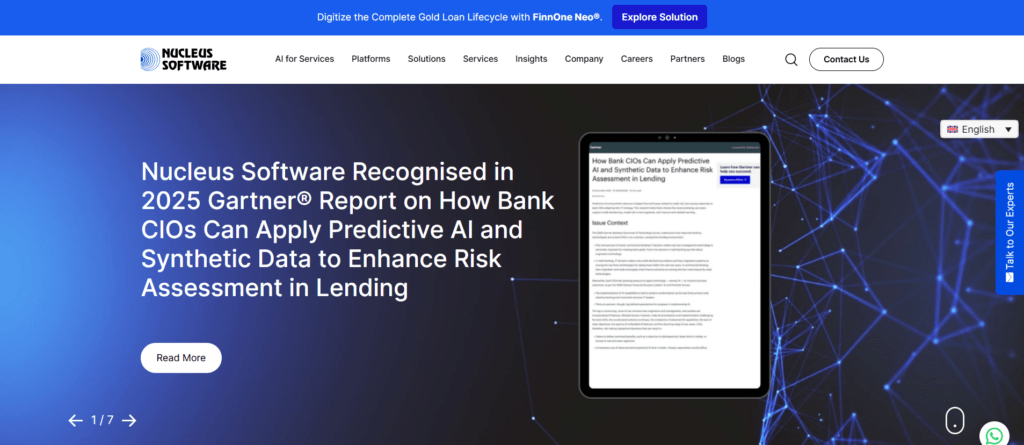
Nucleus Software’s FinnOne Neo platform supports the Islamic finance journey across retail, corporate, and commercial financing, with configurable contract types built for institutions across Asia and the Middle East that need to structure home, auto, personal, and asset financing around profit-sharing or lease-based models instead of interest.
Institutions managing large financing portfolios, particularly around vehicle, commercial, or equipment finance, tend to get the most out of their configurable workflows and servicing tools.
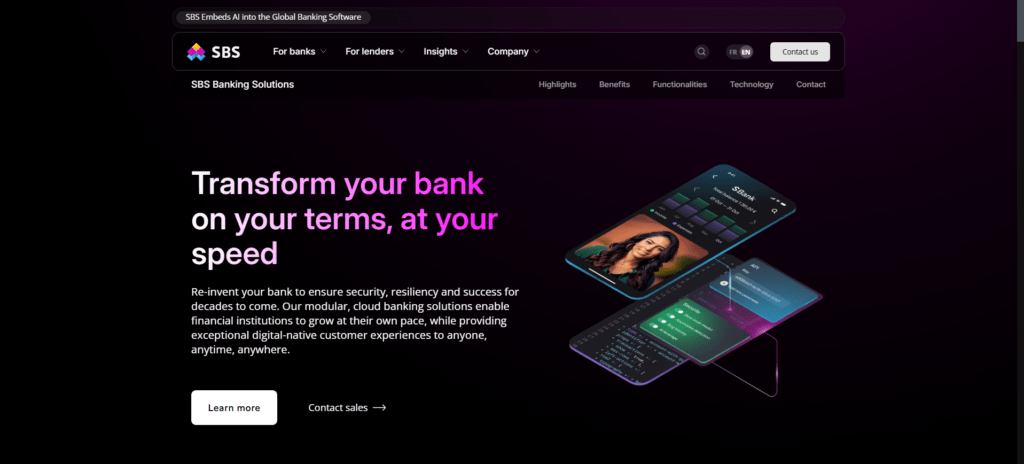
SBS, formerly known as Sopra Banking Software, offers core banking and lending tools used across several regions, with Islamic finance sitting as one part of a wider banking offering rather than its main focus.
The platform still gives institutions room to build customized Sharia-compliant lending products and connect them to existing banking infrastructure, which banks operating across multiple regulatory environments tend to find useful.
As with most enterprise banking systems, getting the most out of it generally requires an experienced technology partner and a dedicated internal project team.
Oracle Financial Services
Oracle Financial Services provides enterprise banking software used by many large commercial banks worldwide, and institutions running Islamic banking products can configure Sharia-compliant financing workflows on top of Oracle’s data management, reporting, and analytics tools.
Large organizations handling millions of customer accounts tend to value the scale Oracle offers, though for smaller Islamic lenders, the platform can bring more complexity than a lending-specific system would.
Path Solutions (iMAL)
Path Solutions deserves particular mention because it built its flagship platform, iMAL, specifically around Islamic finance rather than adapting conventional banking software after the fact.
It remains the only Islamic core banking platform certified by AAOIFI, and it supports a wide range of Sharia-compliant products including Murabaha, Ijara, Salam, Istisna, Musharakah, and Mudarabah, with accounting and reporting built around Islamic banking practices from the start.
Path Solutions was acquired by Azentio Software in 2025 and now operates as Azentio iMAL, serving more than 100 Islamic banks across roughly 40 countries.
For institutions that want software designed from the ground up for Islamic finance rather than retrofitted onto a conventional core, it remains one of the strongest specialized options available.
Which platform fits which type of institution
A newly licensed Islamic digital lender serving small businesses will usually prioritize cloud deployment, open APIs, configurable workflows, and a fast implementation, which points toward a platform like Lendsqr that offers flexibility without years of setup work.
A multinational Islamic commercial bank operating across several countries will likely place more weight on enterprise banking functionality, regulatory reporting, and treasury integration, which tends to favor Temenos, Finastra, Oracle Financial Services, or Path Solutions.
Islamic microfinance institutions, often working with tighter budgets and borrowers who have seasonal or informal income, tend to do best with platforms that support configurable repayment schedules, mobile-first customer experiences, and integration with digital identity and payment systems.
It is worth remembering that no software platform determines whether a financing product actually complies with Sharia principles.
That responsibility sits with the institution and its Sharia supervisory board. The technology simply provides the operational structure that makes administering those products accurately and consistently possible.
How to evaluate and choose a platform
Selecting software here goes well beyond comparing feature lists. These are the questions that tend to matter most once an institution moves from browsing vendors to making a real decision.
Step 1: Confirm the platform supports your specific contract structures, not just “Islamic finance” as a general label. Ask it to walk you through how it handles Murabaha, Ijara, Musharakah, Mudarabah, Salam, or Istisna specifically, since a vague answer here usually means the support is bolted on rather than built in.
Step 2: Ask how the platform documents Sharia compliance for your supervisory board. Confirm it can produce clear, exportable audit trails covering every approval, profit calculation, and contract amendment, since your Sharia board will need to review these regularly, not just at launch.
Step 3: Check how the platform handles asset tracking on an asset-backed product. Ask to see, specifically, how it tracks ownership, valuation, and transfer, since this is where software built for conventional lending tends to fall apart.
Step 4: Map your required integrations before comparing vendors further. Confirm the platform connects cleanly with your identity verification provider, payment gateways, accounting software, CRM, credit bureaus, and mobile money or digital wallet providers where relevant.
Step 5: Test the borrower-facing experience directly. A strong portal should let customers submit applications, upload documents, track status, review agreements, view repayment schedules, and make payments without needing to call support for routine questions.
Step 6: Weigh the implementation timeline against your real capacity. An enterprise platform that takes a year or more to configure may suit a large bank, but it can stall a smaller institution that needs to be running within months.
Step 7: Think about where your institution expects to be in five years, not just today. Check whether the platform can absorb new contract types, new markets, and a larger portfolio without forcing a full replacement later.
Islamic finance keeps growing as more customers look for financing that matches their principles, and that growth is creating real opportunities for banks, fintech companies, cooperatives, and non-bank lenders, along with real pressure on the technology behind them.
Conventional loan systems tend to struggle with financing built around asset ownership, leasing, partnerships, and deferred sales. Platforms built with configurable workflows, proper asset tracking, and strong integrations give institutions a far steadier base to work from.
The right platform depends on the institution’s size, the products it offers, and where it’s headed. A digital lender will likely want flexibility and open APIs. A large bank will likely need full core banking functionality across treasury and retail.
A specialist Islamic institution may prefer software built for non-interest finance from the ground up. Whatever the fit, the software should make it easier to run Sharia-compliant financing accurately, keep records clear, and grow alongside the institution and the industry around it.
Obtaining an FCA consumer credit license is a key step for businesses that want to offer loans, credit cards, BNPL, or other consumer credit products in the UK. This guide explains who needs FCA authorization, the application process, eligibility requirements, expected costs, and practical tips to help lenders navigate the licensing process successfully.
If you’re a non-profit or development finance institution (DFI), it should be easier to run a lending program if you're already doing the hard part of reaching people most others won’t.
The end-to-end loan management software that’s rewriting the rules for lenders globally by offering enterprise-grade features without the enterprise-grade costs.
September 30, 2024
Make Better Informed Decisions
Our decision model Oraculi helps you handle all modules required to form the decision model for your lending business, convenient and
easy.