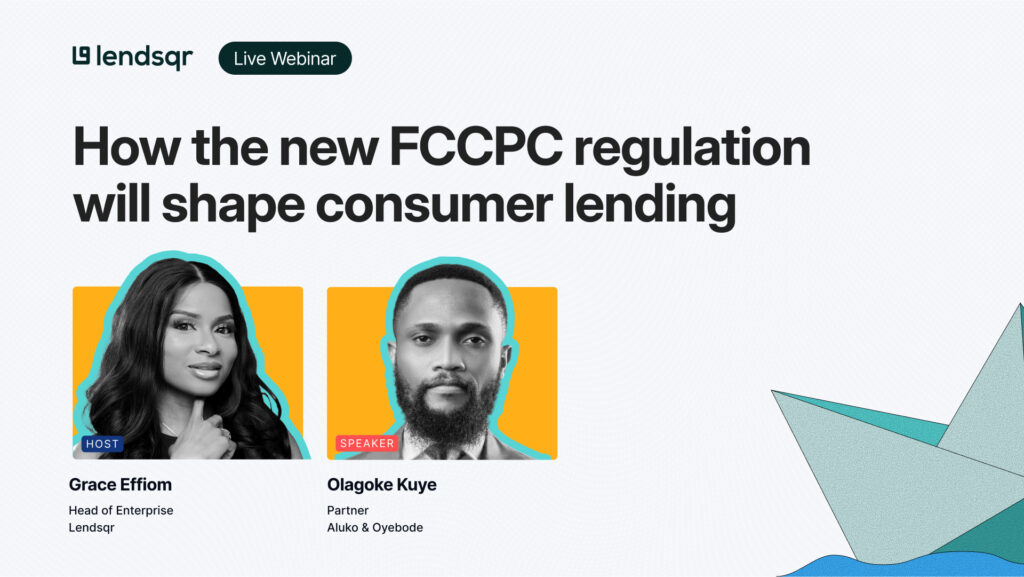
More than 100 attendees from fintech, banking, legal and regulatory circles joined the one-hour discussion led by Grace Effiom (Head of Enterprise, Lendsqr) with Olagoke Kuye, Partner at Aluko & Oyebode, one of Nigeria’s leading law firms. Together, they unpacked the Federal Competition and Consumer Protection Commission’s (FCCPC) new digital-lending framework, its implications for lenders and consumers, and practical steps to achieve compliance.
Setting the stage: Lendsqr’s platform and lender commitment
Grace opened the session by introducing Lendsqr as Nigeria’s most robust SaaS platform for digital lending; powering everyone from start-ups to established brands. She highlighted key platform capabilities:
End-to-end support for loan origination, disbursement, repayment and collections
A wide range of loan products: single-tenor, multi-tenor, savings-linked loans, employee salary loans, travel loans and investment products
Advanced risk-management features: credit-bureau integration, dynamic KYC checks, device and location whitelisting/blacklisting, and liveness verification
A dedicated team offering compliance support, and partner integrations.
She stressed that Lendsqr’s mission is not only to supply technology but also to help lenders navigate regulatory change with confidence.
The FCCPC’s previous 2022 framework focused primarily on digital lenders distributing apps via Google Play or Apple Store. Since then, consumer complaints about privacy breaches and harassment have grown, prompting a new, more comprehensive set of rules. These rules now capture all forms of digital, electronic, online and “non-traditional” lending activities, regardless of how the product is delivered. Grace outlined the session’s agenda:
Overview of the new FCCPC rules
How they differ from the 2022 guidelines
Implications for lenders, vendors, and collaborators
Practical steps to achieve compliance
Live audience Q&A
Key insights from Olagoke Kuye
Here are the key takeaways from Olagoke Kuye during the webinar:
Scope and applicability
Ola Kuye explained that the new rules apply to digital and online lenders operating outside CBN’s direct licensing framework and Service providers, vendors and collaborators that “benefit” from lending transactions (for example, payment processors, data partners, field agents)
He noted that the FCCPC has not yet clearly defined “benefit,” creating uncertainty for third-party providers. Traditional money lenders not using digital or online channels are generally outside the scope but should still monitor developments. “If your business touches lending in any digital form, assume you’re covered until told otherwise” Olagoke advised.
Compliance timelines and enforcement
Olagoke Kuye focused on the timelines:
Existing lenders: 90 days to comply and obtain FCCPC approval
FCCPC’s stated approval time: 30 days, but this is discretionary and may be extended
Under the Business Facilitation Act, licences may be “deemed approved” if regulators don’t act in time, but the new FCCPC rules still prohibit operation without explicit approval, setting up a potential legal grey area
He urged participants to apply early to avoid a backlog and to document all communications with the FCCPC.
Lenders must respect consumer preferences and control over unsolicited marketing messages, going beyond the previous guidelines.
Explicit consumer consent for data processing and marketing
A ban on threatening or harassing communications with borrowers
Cost of compliance vs. risk of non-compliance
Compliance will require:
Hiring or outsourcing a DPO
Upgrading app security and privacy controls
Legal and filing fees
While this may burden smaller lenders, the cost of non-compliance, fines, loss of licence, litigation, reputational damage, is far higher. Early compliance can actually improve business by boosting investor confidence, enabling better pricing, and reducing default risk.
Market impact and opportunities
The speakers predicted:
Increased collaboration or consolidation among smaller players to share compliance costs
More data-driven underwriting, leveraging credit-bureau information, which can reduce defaults and support unsecured lending growth
Opportunities for compliant lenders to differentiate themselves on trust and transparency
Licensing & renewals
Licences expire on 31 December of the third year; renewable for another three years subject to an annual levy
Minimum capital requirements vary by state (e.g. Lagos vs. Ogun); lenders should consult legal counsel or contact [email protected] for guidance
Although skewed toward consumer protection, the new FCCPC framework also encourages lenders to improve credit assessments and leverage credit bureau data, ultimately helping reduce defaults. For third-party providers accessing customer financial data under open banking arrangements, the panel advised direct engagement with the FCCPC to clarify obligations.
Audience questions & clarifications
During the lively Q&A, attendees asked about:
Definition of “non-traditional lenders” (still to be clarified by FCCPC)
Exemptions for traditional money lenders
Capital and licensing fees across states
Impact on unsecured vs. secured loans
Olagoke Kuye also fielded live questions from attendees. Check here to view all questions asked and the responses.
Next steps
Digital lenders should begin compliance preparation immediately to meet the 90-day window.
Service providers and collaborators must assess whether they “benefit” from lending transactions and if they fall under the FCCPC’s scope.
Traditional lenders should confirm their exemption status.
Consumers can expect stronger data protection and more transparent practices.
As Grace Effiom concluded, “These regulations are not just about compliance, they are an opportunity for lenders to differentiate themselves through trust, transparency and stronger operations.”
Want to learn more?
If you have questions about how to comply with the new FCCPC rules or how Lendsqr can support your lending operations, reach out to the team at [email protected] or [email protected].
Obtaining an FCA consumer credit license is a key step for businesses that want to offer loans, credit cards, BNPL, or other consumer credit products in the UK. This guide explains who needs FCA authorization, the application process, eligibility requirements, expected costs, and practical tips to help lenders navigate the licensing process successfully.
If you’re a non-profit or development finance institution (DFI), it should be easier to run a lending program if you're already doing the hard part of reaching people most others won’t.
The end-to-end loan management software that’s rewriting the rules for lenders globally by offering enterprise-grade features without the enterprise-grade costs.
September 30, 2024
Make Better Informed Decisions
Our decision model Oraculi helps you handle all modules required to form the decision model for your lending business, convenient and
easy.