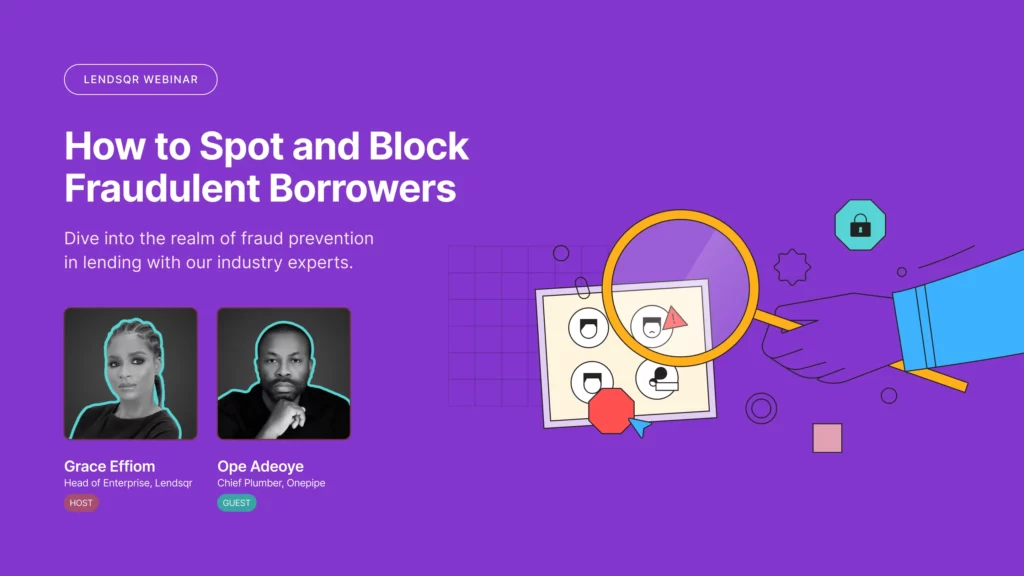
As the threat of fraudulent borrowers in the lending industry continues to rise, lenders are focusing on new strategies to identify and prevent fraud. Grace Effiom, the Head of Enterprise at Lendsqr, hosted a webinar featuring Ope Adeoye, CEO of OnePipe, where they discussed the latest approaches to combating fraud in the digital lending space.
Driving the conversation
Understanding the impact of fraudulent borrowers on lending businesses.
Understanding the behavioral patterns that indicate potential fraud.
Implementing effective techniques to block and report fraudulent borrowers.
Utilizing advanced tools and technologies to enhance fraud detection.
Key takeaways
Understanding fraud in lending
Fraud is defined as intentional deception for financial gain, causing financial loss to others. This can manifest in various ways within lending operations, such as identity theft, fabricated income information, concealed debts, collusion with insiders, and false documentation.
“Fraud is the intentional deception for financial gain to cause financial loss to any other party.” – Grace Effiom
Impact of fraud on lending businesses
Fraud can lead to severe financial damages, as illustrated by examples like Countrywide Financial Corporation’s role in the subprime mortgage crisis. The increase in fraudulent activities, especially in recent years, highlights the growing risk for lenders.
“If I give out money to people, but every time I raise funds and then disburse to people, the money never comes back, that’s going to lead me to bankruptcy.” – Grace Effiom
Effects on customers and Investors
Fraud erodes customer trust, damages reputations, and can lead to financial losses for both customers and institutions. Investors may also lose confidence, affecting stock prices and credit ratings. Regulatory scrutiny may increase, further impacting the business.
“Nobody goes into business to lose money; we all go into business to make money.” pointed out Grace Effiom
Fraudulent borrowers often exhibit certain behaviors that can serve as red flags
These include reluctance to provide necessary information, avoidance of standard procedures, and rapid changes in transaction patterns. Identifying these patterns early is crucial for preventing fraud.
“Reluctance to provide information is a major red flag; if I’m giving you my money, I should be able to ask you for as much information as I need.” – Grace Effiom
Enhancing authentication and security measures
Implementing robust authentication measures, such as multi-factor authentication (MFA) and biometric verification, can strengthen the identity validation process and prevent fraudsters from accessing lending services.
“Enhancing authentication measures and using tools like MFA and biometric verification are key steps in blocking fraudulent borrowers.” – Ope Adeoye
Collaboration and reporting
Collaborating with other lending institutions, law enforcement, and regulatory bodies is vital for creating a collective defense against fraud. Reporting fraudulent activities to credit bureaus and participating in industry-wide information-sharing initiatives are also critical steps.
“Collaboration is key in creating a collective defense against fraudulent borrowers, and reporting them to credit bureaus ensures their activities are reflected in their credit history.” – Grace Effiom
Lendsqr provides various tools and services to help lenders prevent fraud, including liveness checks, image comparison, KYC document review, and real-time data monitoring. These tools enable lenders to effectively filter out fraudulent borrowers and maintain the integrity of their lending operations.
“With tools like liveness checks and real-time data monitoring, we can significantly reduce the risk of lending to fraudulent borrowers.” – Grace Effiom
Adhering to established regulatory frameworks is crucial for lenders to safeguard themselves against fraudulent activities. These frameworks provide the necessary tools and guidelines for identifying and investigating potential fraud cases. By ensuring compliance with requirements such as registering loans with credit bureaus or CRM systems, lenders can demonstrate their commitment to lawful practices, which becomes invaluable when seeking assistance from enforcement agencies.
“Regulations tell us what to do, but we must demonstrate our compliance to get help from enforcement authorities,” emphasized Ope Adeoye.
Choosing between Police and EFCC for loan recovery
The decision to use the police or EFCC for loan recovery hinges on the specifics of the case. Factors like the size of the loan and the severity of the problem play a significant role. As Ope Adeoye put it, “It depends on the size of the loan you’re trying to recover, the degree of the problem that you’re chasing after.” The right choice often depends on the magnitude of the issue at hand.
Reporting a fraudulent borrower to their employer is appropriate when the fraudster has used their job position to facilitate the fraud. This approach requires substantial evidence linking their employment to the fraudulent activity. “If they defrauded you and you can demonstrate that they used their position in the capacity of that employment to aid that fraudulent service, then definitely you can report them,” said Ope Adeoye.
You need the right technology for lending success
We’re in the business of helping lenders worldwide have access to the best technology, and use credit to lift billions to their dreams and a better life.
Obtaining an FCA consumer credit license is a key step for businesses that want to offer loans, credit cards, BNPL, or other consumer credit products in the UK. This guide explains who needs FCA authorization, the application process, eligibility requirements, expected costs, and practical tips to help lenders navigate the licensing process successfully.
If you’re a non-profit or development finance institution (DFI), it should be easier to run a lending program if you're already doing the hard part of reaching people most others won’t.
The end-to-end loan management software that’s rewriting the rules for lenders globally by offering enterprise-grade features without the enterprise-grade costs.
September 30, 2024
Make Better Informed Decisions
Our decision model Oraculi helps you handle all modules required to form the decision model for your lending business, convenient and
easy.