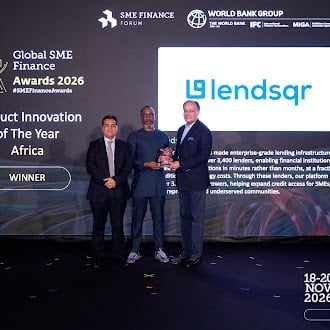
Lendsqr wins Product Innovation of the Year at the 2026 Global SME Finance Awards
Back
Company Updates
Lendsqr wins Product Innovation of the Year at the 2026 Global SME Finance Awards
Last updated November 25, 2026
Oluwademilade Olanrewaju
In this post
Share
Lendsqr has been named Product Innovation of the Year at the 2026 Global SME Finance Awards, presented in Singapore during the Global SME Finance Forum.
The awards are run by the SME Finance Forum, which is managed by the International Finance Corporation (IFC), a member of the World Bank Group. We were one of 50 finalists.
This post covers what the award recognizes, how the week in Singapore went, how our work lines up with what the judges look for, and why the result matters to anyone who wants to lend to small businesses.
What the Global SME Finance Awards recognize
The SME Finance Forum is a global network of financial institutions and industry groups that work on small business finance.
The G20 established it, IFC manages it, and it counts more than 250 members and affiliates across 190 countries, according to coverage of this year’s awards.
Its yearly awards have four categories: Best Financier for Women Entrepreneurs, Product Innovation of the Year, SME Financier of the Year and Sustainable SME Financier of the Year.
Product Innovation of the Year goes to financial institutions for innovative products or services for SME clients. The awards page says the competition is open to banks, non-bank financial institutions, development finance institutions and fintech companies.
Judges score entries on four things: reach, uniqueness and innovation, effectiveness and impact, and dynamism and scalability. Prizes are also given by region.
Last year’s Product Innovation winner for Africa was Co-operative Bank of Kenya, in an edition that drew more than 150 entries from over 60 countries.
The problem we set out to fix
When we started Lendsqr in 2018, building a digital lending platform took about 12 months, more than 15 technology integrations and hundreds of thousands of dollars before the first loan went out.
Cooperatives, microfinance banks, SACCOs and employer funds could have served small businesses, but many stayed on the sidelines or launched systems that did not work well. Expensive informal lenders filled the gap.
The integrations are a large part of why the build took so long. A lender needs a way to verify who a borrower is, a way to pay money out, a way to collect repayments, a source of credit data and a system that ties all of it to the loan record.
Each connection has to be built, tested and kept working, and a team that wants to lend to farmers or market traders rarely has engineers to spare for that.
We built Lendsqr so that an organization could become a lender without that bill. Today a lender can go live on Lendsqr in as little as 20 minutes at about 5% of the cost of building a comparable platform.
Borrowers can apply through web, mobile, USSD and API channels, and the USSD option means a business owner without a smartphone can still ask for credit. Our Oraculi engine handles credit decisioning, and lenders can approve loans manually, automatically or with a mix of both.
Money goes out by instant disbursement to any bank account, and repayments come in by direct debit, card or bank transfer. A lender can run the platform under its own brand or build its own front end on our backend, which suits institutions that already have a product team and only need the lending engine behind it.
It ran alongside the Singapore FinTech Festival, so policymakers, regulators, banks and technology companies were in the same city for the same three days.
For a company that builds lending technology, the last word in that theme is the one that applies most directly. Lenders also need customers to lend to and money to lend, though, and technology is what connects the two. That is the thread our work follows.
The 2025 Forum took place in Johannesburg as a side event of the G20’s financial inclusion working group, so the gathering has a record of bringing lenders and policymakers into the same room.
The awards ceremony was part of this year’s week. Pakistan’s Finance Minister, Muhammad Aurangzeb, attended and presented awards to winners in several categories.
The Bank of Punjab took the Product Innovation award for Asia. Only one person from Lendsqr made the trip: our CEO, Adedeji Olowe. He attended the Forum and the ceremony on behalf of the whole team.
After the announcement, Adedeji shared the news with our active lenders, our other lenders, our international customers and former members of the Lendsqr team, and he said everyone was excited. “Access to credit is hard in Africa, and running a small lender is harder still,” he said. “We built Lendsqr so that any organization can become a lender, and so that lenders can focus on giving credit to families and businesses. This recognition from the Global SME Finance Awards tells us the model works well beyond Africa.
How our work matches the judging criteria
Reach is the first test. Thousands of credit providers in different countries now run their lending on Lendsqr, and between them they serve millions of borrowers, among them SMEs, micro-entrepreneurs and artisans. Each lender on the platform makes its own loans, and our job is to make it possible for the next lender to start.
Innovation is the second. We treat lending as infrastructure that any organization can switch on. A cooperative, a microfinance bank or an employer fund can open a free Lendsqr account, set up loan products in an admin console and give borrowers a web app to apply and track their loans, with no 12-month build.
Effectiveness is the third. The measure we care about is whether lenders reach the market, and the shorter launch time and lower cost described above are the clearest evidence.
A lender that can launch in minutes can test a product with a small group of borrowers before committing a large budget. If the product works, it grows. If it does not, the lender has lost days and not a year.
Scalability is the fourth. Our pricing starts with a free plan and moves through Pro and Business to a custom Enterprise plan, so the cost grows as the lender does.
A small cooperative and a large institution can use the same platform, with the Enterprise plan adding options such as an on-premise deployment license for lenders that must host the software themselves.
Part of that gap comes from lenders who never get started. An organization that knows its community and wants to lend can be blocked by the cost and time of the technology alone.
Every lender that clears that hurdle is one more place a small business owner can borrow at a fair price, and one less reason to turn to an informal lender with steep terms.
Picture an employer fund that wants to give staff short loans, or a cooperative that wants to finance its members’ market stalls. Both know their borrowers well. Neither has the technology team that a bank would use to build a lending system.
When the platform is something they can open in an afternoon, the question changes from whether they can afford to build it to which loan product to offer first.
What this award asks of us next
We are grateful to the SME Finance Forum and the judges, and to the customers, partners and Lendsqr team members who made the entry worth judging. The lenders who run on the platform did the work of reaching borrowers, and this award belongs to them as much as to us.
Winning does not change what a lender needs from us on an ordinary Monday: disbursements that arrive, collections that reconcile and reports that can be trusted. We intend to keep working on those, because they decide whether a new lender stays in business.
There are still millions of businesses without credit, and plenty left to build. If you run a cooperative, a microfinance bank, a fintech or a fund and want to lend, you can create a free Lendsqr account and see how quickly a first loan product comes together.
Obtaining an FCA consumer credit license is a key step for businesses that want to offer loans, credit cards, BNPL, or other consumer credit products in the UK. This guide explains who needs FCA authorization, the application process, eligibility requirements, expected costs, and practical tips to help lenders navigate the licensing process successfully.
If you’re a non-profit or development finance institution (DFI), it should be easier to run a lending program if you're already doing the hard part of reaching people most others won’t.
The end-to-end loan management software that’s rewriting the rules for lenders globally by offering enterprise-grade features without the enterprise-grade costs.
September 30, 2024
Make Better Informed Decisions
Our decision model Oraculi helps you handle all modules required to form the decision model for your lending business, convenient and
easy.