Loan recovery sits at the intersection of credit risk, operational capacity, and regulatory compliance. When loans go unpaid lenders risk not just financial loss but disruptions to capital allocation, pressure on liquidity, and higher long-run cost of funds.
Many lenders find that a well-chosen loan recovery partner helps reduce that burden by engaging overdue accounts on behalf of the lender, keeping recoveries aligned with ethical and legal expectations, and returning funds that can be reinvested back into the business.
This article examines five leading loan recovery providers operating in Nigeria. These organisations specialize in areas such as debt collection, negotiation, skip tracing, and legal enforcement. Each brings a different level of expertise and operating model.
For lenders in Nigeria and other African markets, understanding these differences and how they fit into Nigeria’s regulatory and market environment will guide smarter decisions in managing delinquent portfolios.
Loan recovery has always been part of lending, but its importance changes depending on the economy and credit systems. In Nigeria, the economy experiences uneven growth, changing employment patterns, and rising prices, all of which affect how borrowers repay loans. Many lenders also work with small margins and limited staff, making it hard to follow up on overdue loans while approving new ones and managing risk.
The broader industry context includes limited credit bureau penetration in some regions, inconsistent address databases, and borrowers with irregular income streams, all of which complicate recovery. Lenders that choose the right recovery partner can reduce the administrative burden, comply with consumer protection norms, and focus internal resources on underwriting and loan growth.
Below are five providers with distinct approaches, each suited to different recovery needs.
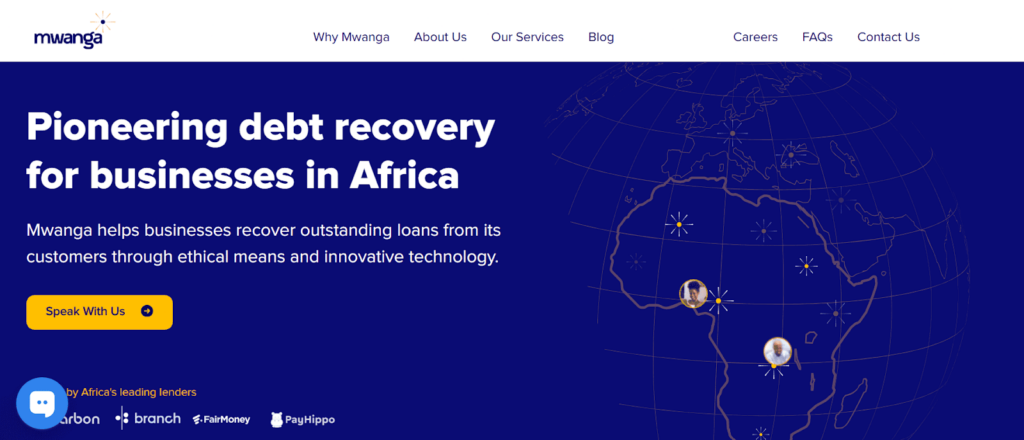
Mwanga
Mwanga has positioned itself as a debt recovery service with a focus on ethical debt engagement and methods adapted to African markets. The firm works with businesses of varying sizes and has built scale in managing delinquent portfolios across segments.
Mwanga’s model combines outbound customer engagement, including tele-collections and field interactions, with tailored recovery strategies that reflect a lender’s business context and customer behavior patterns. The organisation reports contact with hundreds of thousands of unique customers and recovery of significant volumes of delinquent loans over time.
One factor that Nigerian lenders appreciate is that Mwanga generally links its fees to recovery outcomes. Lenders can avoid upfront costs by agreeing to a fee structure that only applies when recoveries happen. This alignment reduces cash flow pressure while still providing expertise for engaging overdue accounts.
Mwanga focuses on respectful dialogue and engagement strategies that seek to preserve customer relationships where possible. That is important in markets where reputation for fair treatment influences future borrowing behavior and brand perception.
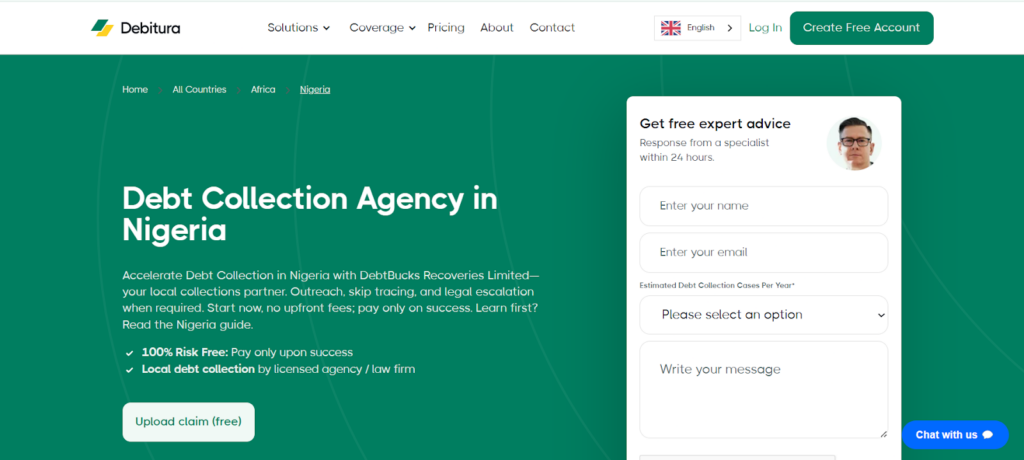
Debitura (via DebtBucks Recoveries Limited)
Debitura operates globally as a technology-enabled debt collection platform. In Nigeria, Debitura’s local partner is DebtBucks Recoveries Limited, a collections firm registered and active in the Nigerian market.
Rather than acting solely as a standalone agency, Debitura provides a case management portal that lets lenders submit delinquent accounts and monitor recovery actions in real time. This visibility can be particularly useful for lenders with large portfolios or teams in multiple cities.
The pricing structure is typically risk-aligned, meaning lenders pay fees only when recoveries occur. That approach supports tighter budgeting and reduces upfront cost exposure for microfinance institutions and smaller credit providers that may not have large recovery teams.
DebtBucks handles pre-legal collection efforts and, where appropriate, assists with steps that move balances toward enforcement through legal channels.
Debitura’s approach is clear and follows Nigeria’s rules, including billing in Naira and following proper conduct standards. Their combination of an online platform and local partner support gives lenders a well-organized way to manage overdue loans.
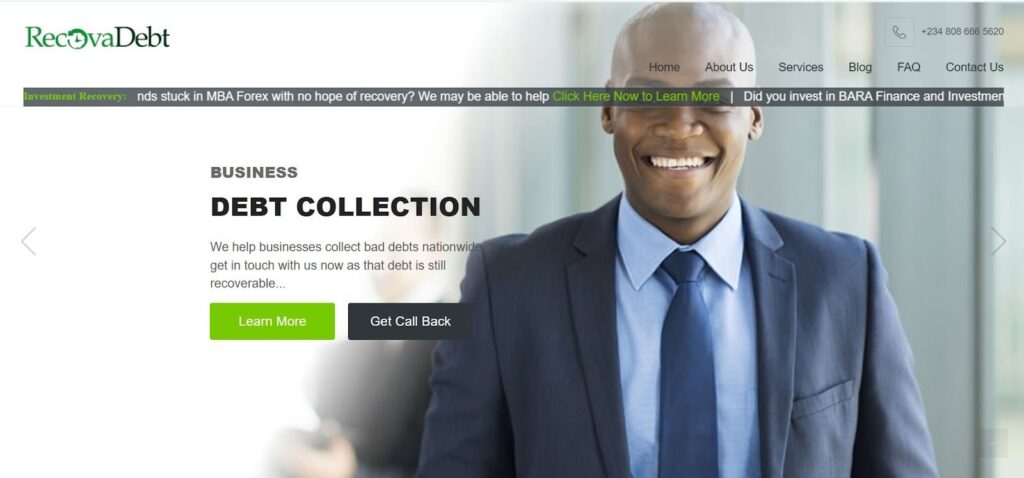
Recova Debt
Recova Debt is another provider operating in Nigeria, especially known for skip tracing and handling challenging or long-standing debts that other agencies have been unable to resolve.
Skip tracing refers to locating debtors who have become difficult to contact, whether due to changes in contact information, relocation, or avoidance.
For Nigerian lenders with portfolios where address or contact quality varies widely, this capability can directly improve the likelihood of recovery engagements. Recova Debt also offers express recovery services and various collection strategies tailored to the debt profile.
A notable point about Recova Debt’s operations is the effort to deploy resources quickly after lender instruction, which can matter when delays increase the risk of further deterioration in contact viability or payment probability. In practice, that means efforts to engage debtors through calls, letters, and, where necessary, referrals to formal legal processes.
While Recova Debt has a commercial orientation, it emphasises ethical engagements and clear communication to creditors about case status, making it a practical partner for lenders with portfolios in diverse sectors including retail finance and business credit.
Ibe, Chido & Associates (ICA)
Ibe, Chido & Associates brings a legal perspective to debt recovery work. The firm focuses on debt collection within the framework of corporate and commercial law in Nigeria.
ICA’s debt collection services incorporate initial assessment of accounts, tailored communication and negotiation with debtors, and legal processes that align with Nigerian civil and commercial procedure.
The firm emphasizes ethics and professional conduct and seeks to balance the interests of lenders with adherence to debtor rights and regulatory expectations.
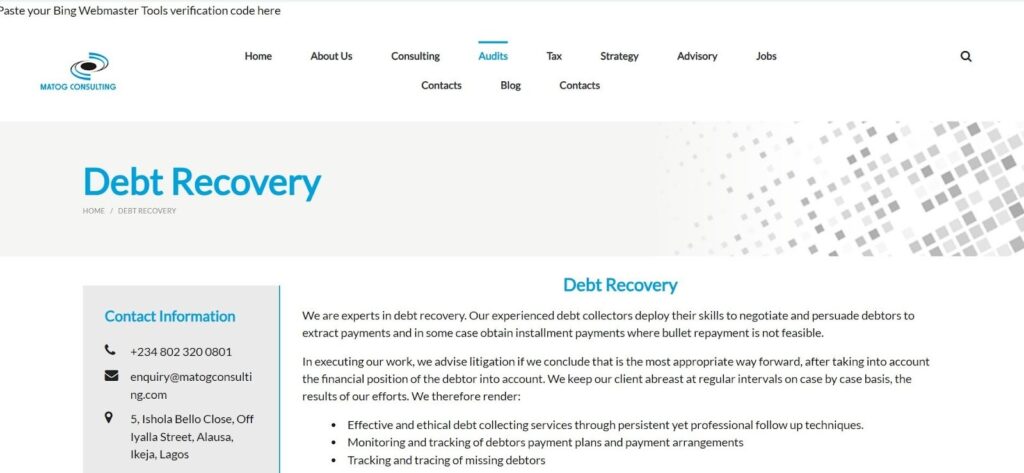
Another firm that supports loan recovery and related advisory services is Matog Consulting, a consulting and professional services company based in Lagos with a range of offerings that include debt recovery.
Matog’s approach is informed by its broader advisory work, which spans audit, accounting, risk management, and restructuring. Within its debt recovery services, Matog engages in negotiation and follow-up with debtors, seeks to establish structured repayment arrangements, and, when appropriate, advises on litigation pathways.
Matog offers lenders the advantage of teams experienced in both accounting and debt recovery. This combination allows lenders to better understand a borrower’s financial situation and identify the most effective recovery strategy.
The firm also tracks missing debtors and provides regular updates to clients, ensuring transparency and visibility throughout the recovery process.
Unlike larger agencies that focus solely on debt collection, Matog integrates advisory and recovery services. This approach is particularly valuable when recovery decisions have implications for financial reporting or restructuring.
How these providers fit within Nigerian lending realities
Loan recovery in Nigeria is shaped by the broader context of credit infrastructure and borrower behavior. Many lenders confront incomplete address records, limited credit bureau coverage in certain segments, and income volatility among borrowers, especially in sectors dependent on informal or irregular work. These realities influence how a recovery partner approaches contact, negotiation, and escalation.
Effective recovery often requires multiple interventions. Initial outreach may depend on calls, emails, and reminders. As cases age or resist repayment, skip tracing helps locate debtors who have changed contacts or locations.
When negotiation stalls, legal partners assist with enforceable options in court. Throughout this progression, understanding consumer protection norms and data privacy requirements remains essential.
Nigerian regulators emphasize that loan recovery must be conducted in a respectful and lawful manner. Guidance from the Central Bank of Nigeria and other authorities requires lenders to uphold consumer rights and prohibits intrusive practices, including contacting relatives without the borrower’s consent.
Lenders that rely on external recovery partners benefit most when those partners align with regulatory expectations and communicate openly about progress and constraints.
Transparency around fee structures, reporting intervals, and escalation triggers helps lenders make informed decisions on when to engage internal teams versus external expertise.
A smarter way to recover loans
Loan recovery remains a key part of lending in Nigeria, where repayment patterns and economic conditions affect portfolio performance. Providers like Mwanga, Debitura, Recova Debt, ICA, and Matog each offer different strengths, from outcome-based pricing and structured processes to legal support and advisory insight.
Choosing the right partner helps lenders improve cash flow, reduce internal workload, and maintain compliance, supporting more sustainable lending practices over time.
Beyond recovering overdue funds, partnering with specialized providers enables lenders to concentrate on expanding their portfolios while sustaining consistent engagement with borrowers.
It also ensures that recovery processes comply with regulatory requirements and ethical standards, safeguarding both the institution’s reputation and its long-term customer relationships.
In practice, integrating these providers into credit operations can enhance risk management, reinforce repayment discipline, and generate data-driven insights that inform more effective lending decisions across Nigeria and other African markets.
Obtaining an FCA consumer credit license is a key step for businesses that want to offer loans, credit cards, BNPL, or other consumer credit products in the UK. This guide explains who needs FCA authorization, the application process, eligibility requirements, expected costs, and practical tips to help lenders navigate the licensing process successfully.
If you’re a non-profit or development finance institution (DFI), it should be easier to run a lending program if you're already doing the hard part of reaching people most others won’t.
The end-to-end loan management software that’s rewriting the rules for lenders globally by offering enterprise-grade features without the enterprise-grade costs.
September 30, 2024
Make Better Informed Decisions
Our decision model Oraculi helps you handle all modules required to form the decision model for your lending business, convenient and
easy.